

 Reading, and learning from other parents can make a big difference in your family’s autism journey. Often something I read or another parent’s wisdom proved life-changing. I’ve developed this autism resource page with that hope for you.
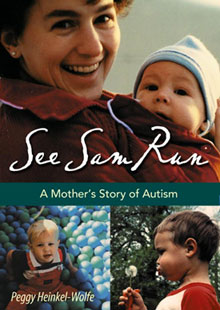
When my autistic son was a toddler, I repurposed a journal to collect autism resources. I turned to that collection when the publisher of See Sam Run asked for an autism resource list.
That original list, now updated, may be most helpful to younger families. I’ve also added resources from current and upcoming books, along with blog links helpful to families of teens and adults with autism. I will keep this page updated and please sign up for my newsletter here.
Younger families may notice these resources lean toward general information. There’s a reason for that. As a young mom, for example, I remember hunting for information on toilet training. No one seemed to have the checklist that would help us succeed. Eventually, I learned mastering the big ideas, not checklists, made the difference. After all, you are one-of-a-kind and so is your child.
In my second book with Shahla Ala’i-Rosales, Responsible and Responsive Parenting in Autism: Between Now and Dreams, we share some of those foundational ideas. Families can make good, sustainable progress when we rely on learning, connecting, and loving.
Autism resources for learning
“Learning is fundamental to raising any child, but takes on a special meaning for every single person involved in an autistic child’s life,” Shahla Ala’i-Rosales and Peggy Heinkel-Wolfe, Between Now and Dreams
Information networks
Formed in 2006 by two self-advocates, this group run by and for autistic people, “Nothing About Us Without Us,” focuses on public policy, scientific issues, and disability rights.
This grassroots group has evolved since its founding in 1965. They remain a flagship for autism information and advocacy, with local chapters in about 70 communities nationwide. It is home to the Autism Justice Center, which is developing resources for legal professionals, including public defenders, to better represent and support Autistic clients.
Founded in 2005 to support autism research, this nonprofit raises private funds for research and advocates for public funding. It also offers some basic information and support to families. Wikipedia has more information the group’s controversial history in relation to vaccines and its early views of autism as a disease.
American Speech-Language-Hearing Association
Their website includes valuable information for parents to help foster speech development, which often comes slowly in young children with autism.
Other information sources
The website links to information about, and encourages doctors to take the time for, developmental screenings.
Checklist for Autism in Toddlers (CHAT)
This screening instrument for children eighteen months old was first described in a paper by Simon Baron-Cohen. Researchers have been refining the checklist, which is offered in multiple languages and can be administered at home.
Journal of Autism and Developmental Disorders, Autism Research, and other research publications
Leading research journals can be a resource for doctors and allied health professionals as well as teachers and parents. Original papers cover behavioral, biological, educational, and community aspects of autism. One of Sam’s speech therapists encouraged us to read autism research, telling us to simply skip past the literature review and methodology, which can be difficult for the lay reader, and go right to discussion and results. Those sections often had new, useful insights.
Recommended autism parenting books, reading
From See Sam Run, with updated annotations
- Ayres, Jean A. (2004) Sensory Integration and the Child. Los Angeles: Western Psychological Services.
Ayres draws on extensive clinical experience to develop sensory integration theory. A seminal work for occupational therapy, she describes sensory dysfunction in meaningful ways.
- Farrow, Elvira and Hill, Carol (1975) Montessori on a Limited Budget: A Manual for the Amateur Craftsman. Ithaca, N.Y.: Montessori Workshop.
Filled with simple projects you can make or build.
- Frith, Uta (2003) Autism: Explaining the Enigma. Malden, Mass.: Blackwell, 2003.
I found the case descriptions created a picture of autism far less abstract than lists of general characteristics.
- Harris, Sandra L. and Glasberg, Beth A. (2003) Siblings of Children with Autism: A Guide for Families. Bethesda, Md.: Woodbine House.
- Montessori, Maria (1995) The Absorbent Mind. New York: Holt.
Dispatched to teach the children living in the slums of Rome, Maria Montessori was ahead of her time in observing and describing the way children learn, “a child’s work.” Children are ready to soak up all they can through their five senses, she says.
- Montessori, Maria (1964) The Montessori Method. New York: Schocken Books.
She describes the science behind the learning activities that she designed. The most important idea was that of toys that teach, designed so that a child can readily see errors and fix them.
- Powers, Michael D. ed. (2000) Children with Autism: A Parents’ Guide. Bethesda, Md.: Woodbine House.
Foundational guide to the special education system.
- The full bibliography and suggested readings from Responsible and Responsive Parenting in Autism: Between Now and Dreams
Links from the blog
Retain more of what you read by listening to the book, or why we created an audiobook of Responsible and Responsive Parenting in Autism: Between Now and Dreams.
Autism resources for connecting
“No parent raises a child alone.” Shahla Ala’i-Rosales and Peggy Heinkel-Wolfe, Between Now and Dreams
People and places that build community
There’s no support quite like a parent who’s been there. This national network began in Nebraska in 1971 and has a version in nearly every state. In addition to helping build one-on-one peer support, some host online meet-ups and local conferences to build connections and resources.
In See Sam Run, I write about our visit to a preschool in Syracuse which opened our eyes to the power of inclusion.
Lekotek, adaptive toys, and toy libraries
Lekotek was an international network of toy libraries, adaptive computer devices, and trained therapists who help children with disabilities develop through play. There are still toy libraries out there (some are membership-driven) that can help you find adaptive toys and services.
PATH, the Professional Association of Therapeutic Horsemanship
Horseback riding reinforces a social relationship between the rider and the animal. Programs accredited by PATH have submitted to outside review of their programs and operations.
This publishing company specializes in educational books and guides. Their conferences bring together authors, parents, teachers, and people with autism.
Other community-building ideas
Conversations for autism parents
- "Responsible and Responsive Parenting in Autism: A conversation with Peggy Heinkel-Wolfe." Mother's Guide Through Autism, July 27, 2025. URL
- “Finding Confidence as a Parent”. Moms Talk Autism, June 3, 2024. URL
Conversations highlighting healthy parent-professional partnerships
- "Supporting Parents - A Conversation with Shahla Ala'i-Rosales". The Behavioral View, February 27, 2025. URL
- “Our Next Guest, A Conversation with Drs. Shahla Ala’i-Rosales and Bridget Taylor, and Peggy Heinkel-Wolfe”. Behavior Live (CEUS available), Summer 2024. URL
- “Importance of Family Guidance”. ABA Unfiltered, March 21, 2024. URL
- “ABA as a Science of Love and Change with Dr. Shahla Ala’i-Rosales and Peggy Heinkel-Wolfe”. Autism Outreach, August 15, 2023. URL
Book clubs
- Host a book club with other families to read and discuss important concepts from Responsible and Responsive Parenting in Autism: Between Now and Dreams
Suggested questions to read and discuss Between Now and Dreams
- From Between Now and Dreams, some of Shahla’s resources for teachers, therapists and clinicians
Shahla's discussion guide for a professional's book club
How to buy these books on autism parenting
See Sam Run: A mother's story of autism is available at Texas A&M Consortium
Learn more about the story behind See Sam Run.

Responsible and Responsive Parenting in Autism: Between Now and Dreams, 2nd ed.
Responsible and Responsive Parenting in Autism: Between Now and Dreams
And, Loving
“Love is among the few things are not fragile in our changing world. Working together with kindness, patience, and compassion is always a great bet. Love gives us the courage to forge through troubles and find paths toward progress.” Shahla Ala’i-Rosales and Peggy Heinkel-Wolfe, Between Now and Dreams
Links from the blog
I’m highlighting three posts here, but you can use the Categories tool to hunt for other posts under the themes of “love,” “hope,” and more.
Refrigerator mothers 2.0. “How much did those early theoreticians consider and—most importantly, rule out—before concluding they’d observed a pattern of mothers who don’t love their children?”
The children are watching. “Movies, like any media, imprint and reinforce social constructs. I’m rooting for the stories that push our humanity toward justice – and love.”
How to raise a hater. “Our kids will do things, learn things, seek things that make us uncomfortable. We have to let them. They will still love us.”
Reading recommendations
From See Sam Run, with updated annotations
- Rolfe, Randy. (1990) You Can Postpone Anything but Love.New York: Warner Books, 1990.
Rolfe underscores that we all come into the world as loving beings and that layers of loving interaction sustain love’s vibrancy.
- Social Stories. Once social cues are described, kids with autism usually know how to respond. Social Stories can be a gentle, effective way to communicate social cues. The collection has been updated here.
Create your own Between Now and Dreams Bookmark for special education meetings
Many parents and caregivers find special education team meetings stressful. A bookmark, with a picture of your child on the front and a helpful list on the back, can assist you with important actions throughout the meeting and foster more trust between the family and the team. In pages 96-97 of the second edition, we explain the purpose and the science behind the bookmark.
Instructions: Download the pdf 8 Tips Bookmark and insert a photo of your child, print, fold in half, and secure. (Prints to 5" x 7", and folds to 2.5" x 7")