

Posts by Peggy
Catching
Sam has a certain smile that really sings.
He’s such a deep thinker that we don’t get to see this smile very much. Like the smile-for-the-camera smile most of us have, his face looks posed in photographs, only more so. But when a happy moment comes — like that moment when sunlight makes it through the clouds and trees all the way down to the ground to light a patch of wildflowers — Sam’s smile just sparkles.
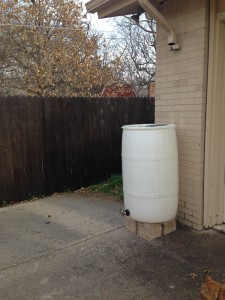
He lit up that way yesterday when I showed him the rain barrel I brought home from a workshop. “We’re bringing the farm,” he said.
Well, almost. This is the barrel.
This was the farm’s.
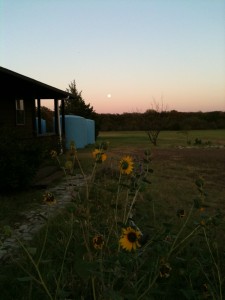
We are growing vegetables in beds on the other side of the fence. That 50-gallon barrel should go a long way toward keeping things watered.
I’ll be writing about the rainwater catchment class and the barrel for Monday’s paper.
We have settled into the new place here in town pretty well. We enjoy the many and varied offerings that come with city life. We’ve all got bicycles and ride them around town more and more. But it’s not the same as life on the farm.
We made a very intentional choice to look around at what was missing and bring it in. The rain barrels, and living life closer to the rhythm of the seasons is part of that.
When you see blue-eyed grass covering our front lawn in the spring, you’ll know we finally got it as close as we could.

Cake in a jar
The first time I ever had cake in a jar was in Tokyo. The people who would become my friends and colleagues were kind enough to stock my apartment refrigerator when I first moved in. They filled it with things they thought a Westerner would like to eat. At the time, I had no idea what half the stuff was, but it was all delicious.
The first little cake in a jar was a revelation. It was so moist and flavorful, I didn’t miss the icing at all. I hunted in the fridge for a second jar and was thrilled to find it.
After I moved back home, I spent many years trying to replicate other delicious dishes I had there — shabu shabu, yakitori, tonkatsu, sushi — at home. (Honestly, the hunt has never ended.) It wasn’t until nearly a decade later, when a friend handed out little cakes in a jar as Christmas gifts, that I remembered those little cakes from my first days in Japan. She shared her recipes, which came from the Cookbook Cupboard in Austin.
Paige helped me make a pile of little cakes last weekend so I could bring them to work to help us get through election night. (She asked whether it was possible to make up your own mixes and skip the boxes. Yes, I had done that in the past and it does improve the recipe. But more on that later.) The original recipe calls for the cakes to be baked in pint jars, but if you want to do a single serving, put them in half-pint jars. The amaretto cakes will cook up a little faster, but the kahlua cakes still take nearly an hour.
Amaretto Cake
1 box of classic white cake mix
1 small box of vanilla pudding
1 cup of canola oil
4 eggs
1/2 cup water
3/4 cup amaretto
Kahlua Cake
1 box of classic yellow cake mix
1 small box of chocolate pudding
1 cup of canola oil
4 eggs
1/2 cup water
3/4 cup kahlua
Directions for both:
Whisk cake and pudding mix in a large bowl, add remaining ingredients and beat well for several minutes. Fill greased jars about 2/3 and bake at 325 F. for about 45 minutes.
Place lids and rims on the hot jars. If storing for more than a day or two, keep refrigerated.
Advanced Arduino fun
For his birthday, I gave Sam two books with advanced Arduino projects after he worked his way through the initial project book over at The Forge, the maker space at Denton’s North Branch Library.
He made a short video of one of his three builds Monday night.
Chisholm Challenge 2016: English Equitation
Sam said he knew when he went into the ring, he was up against some stiff competition this year. He still had a great ride.
Chisholm Challenge 2016: Showmanship
Sam says the last pivot in front of the judge didn’t go well. The horse, Rosalie, had “her own ideas.”
Guest blog: Sam on tackling trail gates
Today, Sam finished Chisholm Challenge, a horse show hosted for the past 13 years by the Fort Worth Stock Show and area stables that serve riders who are veterans or have disabilities.
Sam didn’t want to talk much about how the trail ride went. (Hint: Not every kernel popped, either today or yesterday.) He did have thoughts about tackling the gate at the end of the trail ride. (Another hint: the gate isn’t a real gate, it’s a rope representing a gate.)
Sam had to both open and close the gate while remaining on his horse, Rosalie. (Yet another hint: This is so difficult that riders at lower levels may be required only to “open” the gate.) Many times, a rider drops the rope before completing the task.
The rules allow them to pick up the rope and try again, at least a few more times. But many riders, once they have dropped rope, simply give up and end the ride.
Sam says he has been thinking about the gate for many years. Here is his advice to riders who are thinking about giving up:
Independent riders should consider a few more attempts to close the gate if dropped. All they need to do is walk the horse up to the side of the gate where the rope still hangs down, haul up the rope without taking it off the gate, then bring the horse to the other side with the rope in hand and finally … CLOSE THE GATE!
As you can see from Sam’s ride today, a little planning, determination and positive thinking goes a long way:
Hard Sauce
The holidays are done and with it, for the most part, the obligation to eat all the things that come out only around the holidays. Our neighbors, an older couple, seemed to think our place was a good place to dispatch the rest of a home-baked cake gifted to them that was more than they could hope to eat.
It was a nice little cake. But I took one look at what was left and knew even the entire Wolfe pack wasn’t going to be able to finish it. It had dried fruits and tree nuts. The middle child is allergic to tree nuts. It wasn’t going to keep well either, the way a proper fruitcake would, because it hadn’t been soaked in bourbon, or brandy, or rum.
(This, by the way, is the problem with nearly every commercial fruitcake. Don’t these bakers know the ONLY way to make a proper fruitcake is to bathe it in booze once a week for at least six weeks?)
That meant I was going to have to take it to work. Just for fun, I made a hard sauce to go with. I didn’t want to put out any kind of memo about the sauce — after all, it reeked of bourbon — but I explained over and over how one might want to warm the cake, and then put a dollop on, and then it would come a little closer to a proper fruitcake. Or maybe make the cake a bit more like bread pudding.
Two of us took home the extra hard sauce. One of the editors on the night desk said he added it to hot chocolate and that was pretty good. I took a bit, too, and left it with the chocolate pound cake we made for Aunt Regina and her 94th birthday. It does appear that Hard Sauce goes with everything.
Hard Sauce
1/2 cup butter, left at room temperature for a few hours until very soft
1 cup confectioner’s sugar, sifted
2 T. bourbon
Beat the butter and sugar until light and fluffy. Fold in the bourbon until incorporated. Chill until firm. Put a heaping tablespoon on a warm dessert, and let it melt in.
Sustainability
Earlier this fall, I was able to spend some time with a local biologist studying quail. I learned more in the course of that day than I was able to put in my newspaper story, which often happens.
The biologist has been working with area ranchers on ways to keep the prairie vital both for their cattle and the quail. On the drive back from Clay County, I saw all the ranches in new ways. Some looked like the ranch we had just visited, lush and vibrant. Others looked used up. I smiled to myself about our farm. When we sold it, our place looked like the former, not the latter.
The biologist started telling me a story about how he’d approached one rancher to bring his land into the quail “corridor.” The rancher agreed, but on one condition: it couldn’t cost him any money.
I could tell the biologist planned on telling me this story a certain way. After all, he was trying to build a big research program and do this good thing for the environment. He needed money for his labs and the students helping with the research. They were bringing new and important scientific knowledge where it was badly needed. The reality likely was this: a rancher that needs to make a change after doing things a certain way for years and years probably needs to spend a little money to get it back right.
Before the biologist got to the big finish in his story about the rancher, I blurted out, “so, really, he asked that whatever you proposed for his ranch be truly sustainable. Because for the changes to last, they can’t keep costing him money, right?”
(This is why people don’t invite me to dinner parties. I’m impertinent. I ask questions that stop the conversation.)
The biologist finished his story, telling me that it took awhile to make the changes to help the quail and figure out the true costs, but ultimately, the rancher didn’t lose any money running his cattle that year. The biologist had delighted in the discovery. But, I could tell by the many long and thoughtful pauses that came after I asked my question that he hadn’t thought about the sustainability of his quail program that way.
We didn’t farm our place with some lofty, progressive, green ideal of it being “sustainable.” We just knew we didn’t have any money and that anything we did needed to be harnessing and directing the little energy we, or the land, already had.
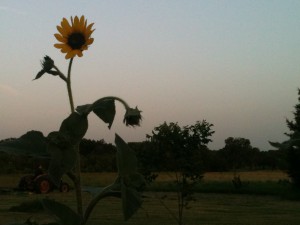
Late summer on the farm
When we tried to help Sam learn to talk and become the marvelous person he was to become, we tried not to focus on hoarding resources. We just tried to harness and better direct the energy we, and he, already had. It worked pretty well.
Sustainability. Its a powerful word. We are starting to use it a lot. I’m not going to let it lose its meaning for me.
WinterFest 2015
It’s been some time since I posted video of Sam riding horse. They had a friendly show at the barn today, just the kids who ride with Born 2 Be in Aubrey. It looked like a good way to get all the willies out before they head to Chisholm Challenge at the Fort Worth Stock Show and Rodeo next month.
After they were all done with their competition, they rode to Christmas music and played a few games on horseback that was a lot of fun to watch. Then, the gracious owners of the facility, Valhalla Stables, rolled out a taco dinner and s’mores over a fire pit in the arena. Best way ever to have an end-of-year party for everyone.
Here’s equitation ride (watch for how Rosalie, the horse, shows the trainers she’s had about enough of the bridle they have on her):
Here’s the trail (watch for the canter over all four poles, and the patient determination at the gate):
And here’s that most excellent fire:
Macaroni and cheese. At last.
When the kids were little, we did our best to feed them wholesome foods made from scratch. But we weren’t rigid about it either. We made one tough rule when we recognized what a Happy Meal could do to your kid’s metabolism.
I used to juggle time at work to be able to take Michael, when he was about 10 years old, to tae kwon do after school. He would beg me on the way home for a snack. There was a 20 minute drive ahead. The McDonald’s drive-thru was two blocks away, so we’d pick up a Happy Meal. Since it didn’t spoil his appetite, I didn’t think there was any harm. However, after about two months of that routine — with two-three Happy Meals a week — I saw a little paunch growing around his belly. I figured out a way to bring Michael a healthy, filling snack for after tae kwon do. And I told Mark I was concerned how fast that change came on.
We decided that the kids could no longer have fast food. To make it up to them, we would make hamburgers and fries once a week.
It was a production, but that’s also when we always had venison in the freezer. We had a bread machine, so that gave me a leg up to make hamburger buns every weekend. On hamburger-and-fries day, we’d cut about 3 pounds of potatoes into sticks and soak them in cold water so they would come out extra crispy. Mark would fire up the grill for the burgers and the turkey frier for the fries, no matter how cold it was outside. I’d run a large paper grocery bag in the microwave for a minute to sterilize it … that’s how we drained all those fries.
It was a great meal and the kids didn’t seem to miss out on fast food.
That routine gave me hope that we could quit mac-and-cheese from a box. I worked hard one Saturday to prepare it from scratch. Oh, how they complained. It didn’t taste right. It was the wrong color. It felt funny in your mouth. I was sorry I made so much, but, of course, the dogs weren’t.
For Thanksgiving this year, I decided to make macaroni and cheese. It had been more than 10 years since my last attempt. I was nervous. I knew Sam wouldn’t like it. He hated mac-and-cheese when it came out of a box. He says cheddar cheese is too “dactyl.”
(Paige and I think he’s invented his own word that mixes meter — a la waltz, long-short-short — with “tactile,” which does not bode well for cheddar cheese’s reputation.)
I knew Aunt Regina would like the mac-and-cheese I made. I knew I would like it. I knew Gus would like it.
I was bold. I made 8 servings. Michael took one bite and said “well, this won’t last the day.”
I had big plans to make leftover hot turkey sandwiches, panini-style, with green apple, bacon and bits of that mac-and-cheese. That didn’t happen. Yes, internet people, this is the one.
Mac and Cheese
1 pound macaroni
2 cups bread crumbs
6 tablespoons of butter, divided
3 tablespoons of flour
1 cup cream
2 1/4 cups milk
1 1/2 tsp. dry mustard
salt, pepper
8 ounces extra-sharp cheddar grated
4 ounces parmesan, grated
4 ounces Swiss cheese, grated
Preheat oven to 350 degrees. Grease a 9×12 casserole dish. Bring a large pot of salted water to boil and cook the macaroni al dente. Drain and return to pot to help it stay warm. Melt 3 T. of the butter and pour over the bread crumbs in a bowl. Grab a handful of the Parmesean and mix together with the breadcrumbs. Set aside. Melt the other 3 T. of butter in a sauce pan, stir in the flour and make a brown roux. Meanwhile, have the milk and cream heating in another pan (but don’t let it get hot enough to get a skin on it.) Slowly add the milk, cream and mustard to the roux and cook until nicely thickened. Stir in all the cheeses, salt and pepper to taste. Pour the cheese sauce over the noodles and gently fold to incorporate. Pour into the casserole and dust the breadcrumbs over the top. Cook for 20-25 minutes until bubbling throughout and brown on top.