Posts by Peggy
What we did on our Irish vacation
Paige put together a series of short videos that, as a good friend says, takes you with us to Ireland. We signed up for a bicycle tour with VBT.com, which kept us cycling for several hours a day most days. We spent most of our time along the Wild Atlantic Way: County Clare, the Aran Islands, Galway and Connemara. We also spent a little extra time in Dublin.
Enjoy.
Episode 1: The one where Paige packs her suitcase
Episode 2: The one where we try to stay awake in Ennis
Episode 3: The one with the cliffs and the food
Episode 4: The one where its raining, just like in Harry Potter
Episode 5: The one with the Galway street performer
Episode 6: The one with the worm hole on the big island
Episode 7: The one with the traditional Irish music and dance
Episode 8: The one where we take a detour to the beach
Episode 9: The one where we saw the Book of Kells, a whisky distillery, the bog bodies but didn’t film any of it
Episode 10: The one with Christ Church Cathedral
Episode 11: The one where Paige runs with pigeons and finally tries a Guinness
Overheard on the Wolfe House #310
Peggy (seeing the clock read 9 a.m.): Well, good morning! How’s the change to afternoon shift?
Sam: Good. I’m getting all my sleep back.
Be the Bumper Guard
After my family moved from the Midwest to Colorado, we started a new Christmas tradition. My grandmother, who lived in Rockford, would send a little cash instead of gifts for Christmas. She forbid my parents to use the money to pay bills. It was to have fun, she said.
So, Christmas Day, we’d all go bowling. As we grandkids had kids of our own, we kept on bowling for Christmas. Some years we’d take up as many lanes as a league would.
Those first few years, it was hard to watch the little ones learn to bowl. They would hit pins, but they would also throw a lot of gutter balls. The year the bowling alley offered lanes with bumper guards was its own kind of Christmas. The bumpers didn’t eliminate the gutter balls, but the set-up helped the kids figure out what they were supposed to do. It was nice to sit back and let them have at it. They were set up for success: they got a lot more pins and they learned more quickly how to throw. By the second or third year, my nephew was ready to ditch the bumpers and bowl in a lane with the grown-ups. He bowled great games.
My kids are grown and I’ve stopped parenting, but when Sam needs support now, I try to remember to be a bumper guard, just like I did when the kids were little.
We parents need to stand on the periphery of their lives, far enough back that the kids know they are doing things on their own, but that you’re watching, too. They need that internal message that they shouldn’t worry about hitting a lot of pins, and that they are still going to throw gutters, and sometimes the ball is going to ricochet its way down the lane, but just keep throwing and try to get strong so you can throw it straighter each time. And one day you’ll be ready to go without the bumpers. You will hit some spares and strikes and you’ll throw some gutters. And it will all be ok.
I don’t always remember to be a bumper guard. A few weeks ago, I thought someone had drained Sam’s bank account. Fear turned me into a helicopter parent. Of course, my actions, ostensibly to defend his hard-earned money, upset him. And they created other problems that he needed to solve. When I remembered my role and stepped back, he cleaned up the whole mess himself.
Our culture is changing rapidly. To survive and to thrive, all of our children, not just the ones with autism, need to be resilient. We should not stand over them and help them throw all the balls. That’s not how to make a resilient kid. With each situation, each problem, each opportunity for growth, we need figure out where to install the bumper guards, stand back and let them throw.
Love people. Cook them tasty food.
Penzey’s Spices started in my home state of Wisconsin. I’m pretty sure I’ve been a customer for decades, because I remember reaching for a Penzey’s jar the first time I made so many recipes that I’ve been making for decades …
Roast chicken with lemon and rosemary …
Mexican hot chocolate with cinnamon …
Pasta with ginger and garlic …
They used to have just the one store near Milwaukee and I ordered by mail. They have shops all over the country now, but we still order online.
If your order is large enough, they’ll send you a little sample of something. For a few years, they kept sending me a spice blend, BBQ 3000. I guess maybe they thought since I lived in Texas, I would need a lot of that.
Like most Texas meat lovers, I think, I like to mix my own.
This last order, they let me know in a pop-up window what the freebie would be, and asked if it was ok. Dill weed. I clicked yes.
When the box arrived, they’d also sent a colorful bumper sticker. I didn’t put it on my truck. I put it in my front window, because it’s just such a beautiful sentiment.
Love people. Cook them tasty food.
Butterflies
Sam was spared the agony a lot of us get in the home stretch for a new job: the long wait between a successful interview and the offer. On Friday, one rolled right after the other for him. He had the best smile when he announced over dinner that WinCo hired him to work in the warehouse.
Sam sacked groceries at Albertsons for ten years. He didn’t want to become a checker. Sometimes customers are impatient. “I wouldn’t be fast enough for them,” he said. He didn’t want to stock shelves, either. I shopped late enough on the occasional Friday night to see those guys at work. Sam couldn’t be that raucous.
Nothing came his way after he graduated with an associate’s degree and certificate in computer science and technology five years ago. It was frustrating. Once I asked a manager at Albertsons if there was a way for a loyal employee with an education to move up. She shook her head no. There aren’t corporate offices here, she said.
Then Sam got a call. WinCo was opening a warehouse in Denton. They wanted to try to hire people like Sam. He would have to quit his job at Albertsons; participate in a special, six-week training class; and interview for the job at the end. There was no guarantee he’d have the job when he finished the training. In addition, he would only be paid when he was handling actual store product in the warehouse. Otherwise the rest of the training time would be unpaid. This was a Goodwill Industries program. The training included a lot of class time on “soft skills,” like getting along with co-workers, deciding when (and when not) to disclose your disability, interviewing techniques, and the like.
Sam had been in the work force for a decade. He’d been there and done that. It didn’t seem fair for him to quit a job and go without pay for four weeks. But I know I can be skeptical. It’s an occupational hazard. I kept my mouth shut. He had a chance at a job that would quadruple his take-home pay.
(Some nights he’d come home, relay what they learned that day and I’d muse over how it might be nice for the newsroom to get a “soft skills” refresher from time to time. We often seem barely house-trained–myself included.)

Image from Nova: Journey of the Butterflies
This week was all butterflies. I missed the open house Sunday, but Michael and Paige went with him to see for themselves what he was shooting for. We were prepared to help Sam update his resume. No need, he said, the program folks already got his resume all wrapped up. Did he want to do some mock interviewing? Nope, he said, he’d already practiced and had notecards with sample questions and answers. He’d just look them over each night, thanks.
He was visibly nervous Thursday night. A lot had lead up to that day. He made sure he had all his interview clothes ready to go and packed up work clothes, too. After the interview, he expected to be back out on the floor, in his bay, and he needed to wear a sturdy shirt, jeans and his work boots. I kept checking my phone all day for news, but that’s not his style. He was epically impulsive as a child, but now, he almost delights in waiting to deliver good news.
I don’t know who was smiling bigger on Friday night when he told me. If it were Michael or Paige, there would be lots of hugs and backslapping and arm-squeezing. But that, too, isn’t Sam’s style. I told him I’d like to shake his hand to tell him congratulations and how proud I was of him.
He kept eye contact as he extended his hand and gripped mine. Not too hard, not too soft. Up and down, not too fast and not too slow.
I kid you not, dear Internet people.
It was the first time in my life I’ve ever experienced the perfect handshake.
Overheard in the Wolfe House #310
Sam: Today’s the first day. (pauses) I hope I like everyone.
Peggy: That’s a nice goal.
Random thoughts from the first Knob Hills half
Pack 166 people on a single-track trail in the uplands of Grapevine Lake and they’ll spread out quickly; soon enough, it’s mostly just you and the birds for a couple of hours. Except for that guy and his target practice. Flooding is not good for trees. Flooding collects so much of the detritus of our modern life that it obviously takes months for volunteers to pick all of that litter up and haul it off in trash bags. The abandoned refrigerator that was a landmark during the drought is still a landmark, but much further downstream. And it has a twin.
But the sunrise was beautiful.
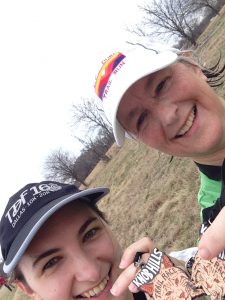
With our finisher medals, at the finish line, because we done did finish it.
A grown-ass man
Sam came home today after spending three days in Fort Worth. He has competed every year at the Chisholm Challenge, a series of horse shows for riders with disabilities. It’s part of the events that lead up to the annual Fort Worth Stock Show and Rodeo.
Sam added another silver belt buckle to his collection, but that wasn’t the big accomplishment this year.
This was the first year, since 2003, that no one in the family was able to go with him to Chisholm Challenge. (So, dear readers, there is no video to share of the many events he rode, both English and Western, including several competitions hosted the first day by the American Quarter Horse Association.)
He’s been going to other horse shows this year as part of his preparations. I’ve been able to get to a few of them. But more often than not, he’d get up early on a Saturday or Sunday morning and drive himself to a nearby arena and compete for the day.
This was also the first year he drove himself to Fort Worth and back. And the first time he traveled to stay in a hotel where he wasn’t with family.
There were always plenty of longtime friends around looking out for him, so I knew not to worry. Some of the good people at Born2Be, where he rides, have known Sam since he was in elementary school. At this point, I think they know, too, how important it is that Sam be his own grown-up self.
I wasn’t there because I was I traipsing around Austin, on assignment to cover the first day of the Texas Legislature. I was doing a whole lot of things I’d never done before, or hadn’t done in a few years. I kept thinking about Sam being in Fort Worth at the same time, also doing a whole lot of things he’d never done before. I became keenly aware each time I was problem-solving. (Am I facing north or south? How do I get to that building? Where’s the elevator? Where’s the bathroom? Where can I plug in the charger for my laptop? Why isn’t the wi-fi working? If I sit here, will I be able to see? Should I leave now, or do I have time to chase that down? Do I have enough gas to get out of Austin before the traffic gets bad? Oh, gosh, I am so hungry.)
It was a lot of problem-solving. That’s what we expect adults to do. Just drop yourself in the middle of something and start solving all the problems. Adults with autism don’t do that very well. They get overwhelmed. People around them step in a lot and help them solve the problems.
Still, kids with autism are no different than other kids: to grow up strong and resilient, they have to learn to solve their problems.
The newsroom I work in has short cubbies. It fosters teamwork, but it also means co-workers often can hear your half of your telephone conversations. One time, a former co-worker was in a testy, problem-solving conversation with his mother, who, as a civil rights activist, is no wallflower. It was hard not to take note when he told her, “I’m a grown-ass man.”
I keep that little descriptor in my head. I know Sam will probably never say it to me, but I want him to believe it about himself, more and more each day.
Yes, he can. He’s a grown-ass man.
Not remedial, but cutting edge.
About a month ago, a television reporter went to elementary school classrooms around these parts to tell us about “wiggle chairs.” The chairs helped first- and second-graders sit at their table and get their work done.
I recognized them instantly. When Sam was in elementary school, he went to the occupational therapy lab once a week at Texas Woman’s University. Students worked with him under the supervision of one of the professors. The students from that first semester (fall 1993) was incredibly sweet. The two students were so excited to be working with Sam (first, autism was rarer back then, and they were clearly helping him a lot) that they made him part of their project in another class, too. They built him a t-stool and gave it to him at the end of the semester.
When I first saw it, I couldn’t imagine how anyone could sit on it. We humans are bipeds. How a person can ride a unicycle or travel down the sidewalk on a pogo stick? Just watching makes me tilt slightly to one side.
Sam didn’t use the t-stool a lot, but I did from time to time, in front of television, for example. Your legs help turn the stool into a tripod. That was the point. You wobbled and wiggled your way to stability.
Of course, the concept went mainstream, although the wiggle chairs they are making for elementary school kids are a little better anchored. You could fall over while sitting on that t-stool if you didn’t pay attention (that’s the point). Most kids bounce. But sometimes they don’t.
This isn’t the first time a therapeutic tool like that has gone mainstream. For example, my former aerobics instructor marveled once during a lunch hour workout that many of the tools our class used (steps, balls, slides, rubber bands) were once physical therapy tools. We should pay close attention the next time one of us was injured and used something new in therapy, she said, joking that we could get rich turning it into a workout routine.
It’s a thing, y’all. Pay close attention to whatever techniques or tool special education teachers and therapists are using. Chances are it’s something cutting edge, and in a year or two, all the teachers will be doing it.
Random Thoughts Running in Eureka Springs
It takes a long time for the sun to come up in the mountains, too. Old men step outside at dawn to drink their coffee and breathe the air and they all remember to say good morning and their dog doesn’t follow you. There is no flat route in the mountains, even old mountains. If you run down, you will run up. But when you are done, you will know the best place to come back and watch the zombie parade.