

Overheard in the Wolfe House #249
Peggy: On the way to bringing you your lunch, I saw a landspout.

Sam: I saw that too! It freaked me out!
Peggy: What did you do?
Sam: I ran back into the store.
Peggy: Did anyone else go outside to see it?
Sam: A few. They couldn’t see it. (pause) I guess that’s the first tornado we’ve ever seen.
Overheard in the Wolfe House #248

Peggy: That was it. We tried to make it too complicated before.
Sam: It’s best to stop when you’re tired.
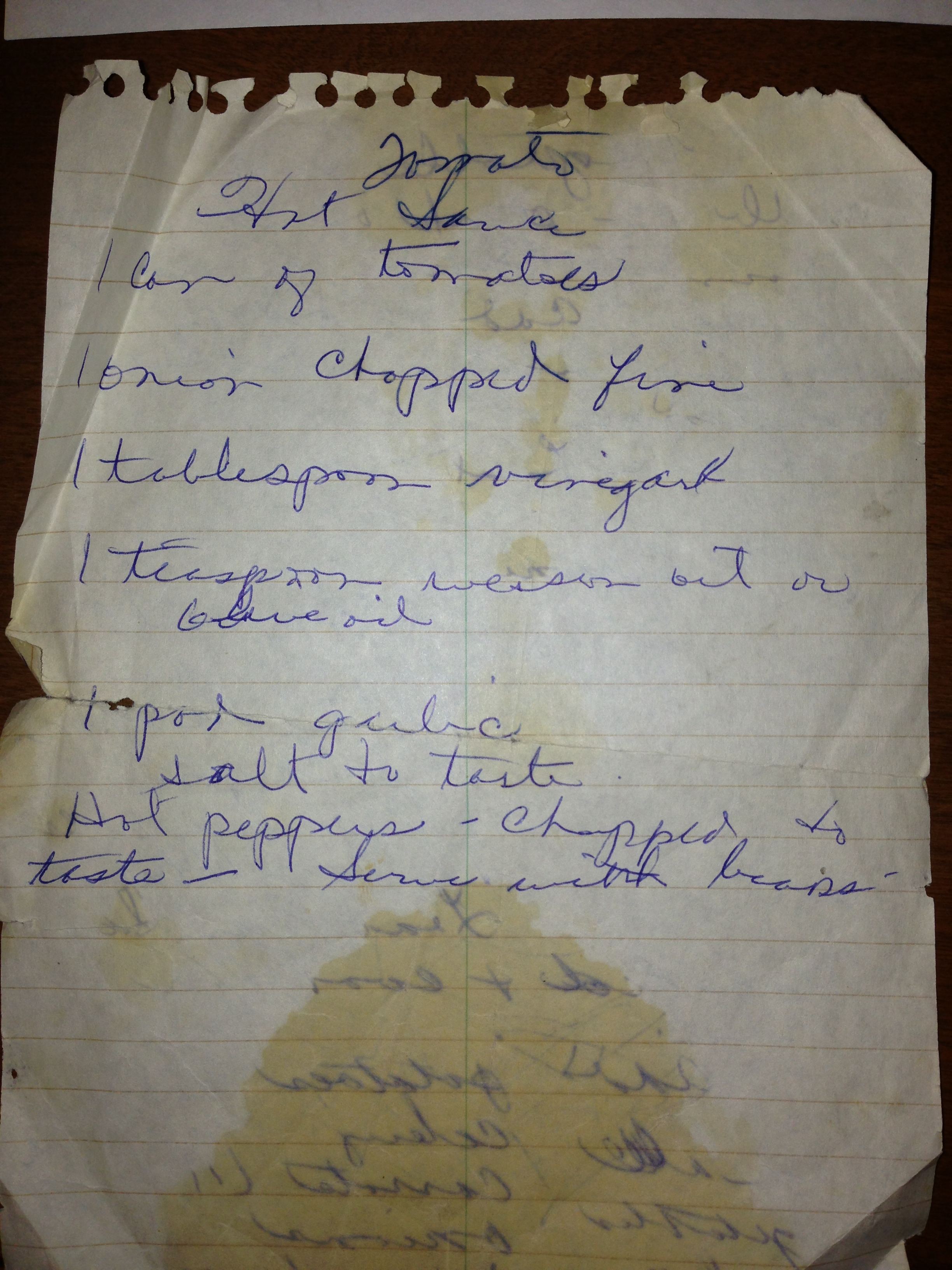
DIY recipes for the pantry: Tomato Hot Sauce
The vinegar and oil, and Aunt Regina’s serving suggestion to put on top of your beans, makes this sound like another tabasco recipe.
Overheard in the Wolfe House #247
Peggy (setting her bag down in the front hall): So how was your day today?
Sam: Better now that you’re home.
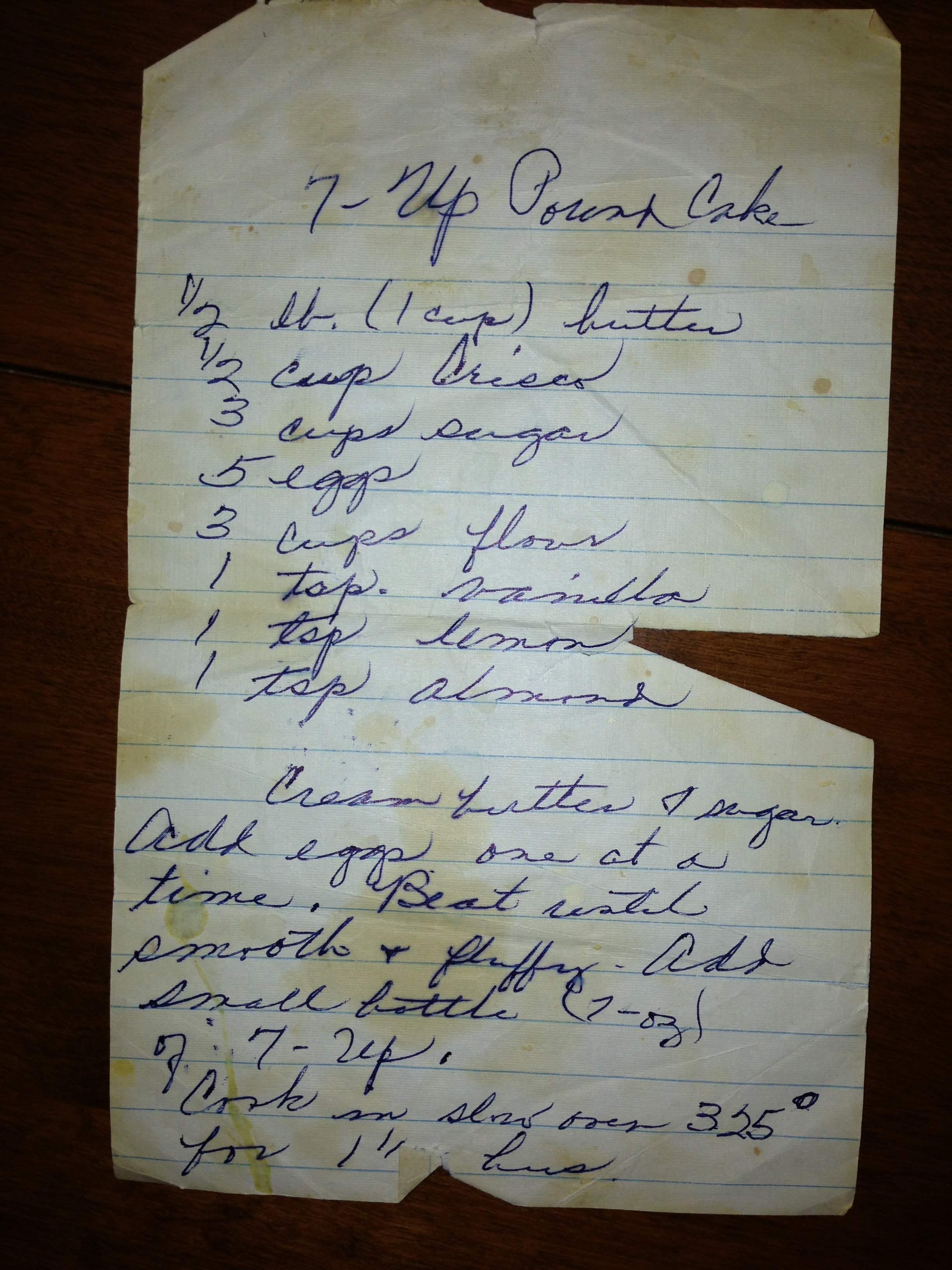
Old-school cakes: Sock-It-To-Me and 7-Up pound cakes
At last weekend’s Denton Blues Festival one vendor was selling Sock-It-To-Me cake and I was reminded of reams of recipes Regina had for cakes.
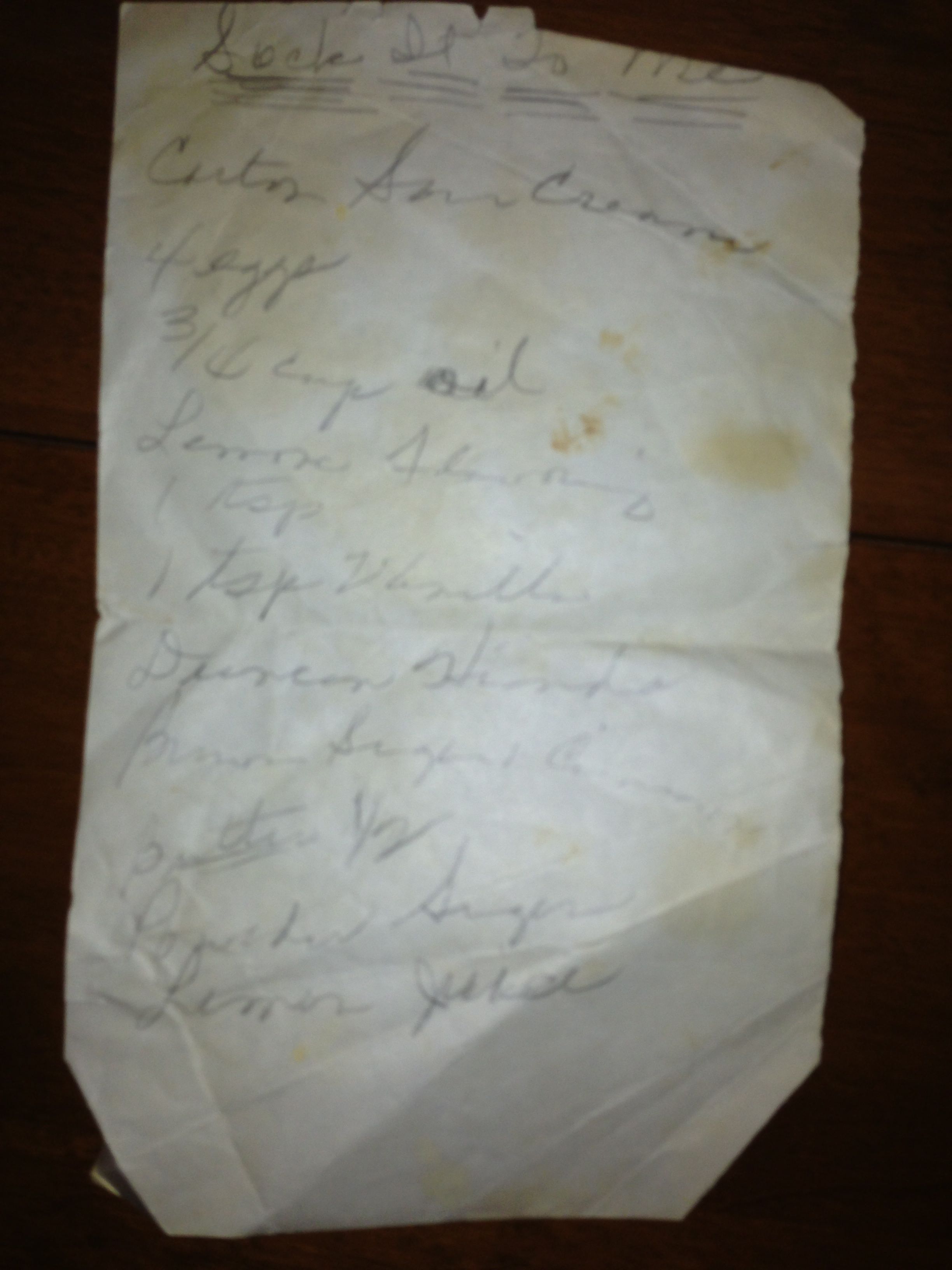
There were so many we didn’t take the time to talk about all of them, but occasionally one would capture Regina or Patti’s imagination. Regina said Sock-It-To-Me was so good.
Regina must have made Sock-It-To-Me cake a lot, because this was her recipe.
(You might be better served finding a recipe elsewhere. I’m told it’s often printed on the box of Duncan Hines cake mix, the way that the recipe for Rice Krispies squares is usually on the cereal box. But I also have seen from-scratch recipes for it on baking blogs, too.)
When we found the 7-Up pound cake recipe, Patti said it was good, but she wasn’t making it anymore because she couldn’t find 7-Up in the store. “And don’t make it with Sprite. I tried. It’s TERRIBLE,” Patti said.
Regina said she gets 7-Up at the dollar store all the time.
I bake cakes from scratch, because cakes from mixes taste waxy to me. Many of Regina’s recipes are from scratch, but not all. My sister, Karen, and I wondered aloud if anyone who cooks seriously still cooks that way (clearly they do, there’s a quarter of grocery aisle committed to cake and frosting mixes). I think it’s interesting that to Regina’s way in the kitchen, if it was a good recipe, it survived. I don’t remember any cake she served ever tasting waxy.
Next week we’ll get back to DIY for the pantry.
Fifty shades of attention
Sometimes the best conversations you have with your kids are in the car on the way somewhere, or while you’re working on something together. I don’t understand why it worked, but we’d get revelations from Michael as we did fence repairs for the goats, for example, or from Paige after we’d get going on sewing project together.
Only in the past few weeks did I come to realize that wasn’t really the case for Sam.
Of course, when he was little, and we discovered that giving him our full attention managed to coax more language and social development out of him, we gave it our all. Mark even took a square tabletop off its pedestal leg and put foot-high 2x2s under all four corners for a play table. We spent hours sitting at that play table with him. Sometimes, it became just like a family dinner table in Japan. We cleared off the toys and sandpaper letter cards and other learning materials and ate our meal there (usually in front of a baseball game, we weren’t saints.)
As Sam grew and his language and schooling caught up, there was much less direct time like that together. We chatted at the dinner table, in the car, just like we did with his brother and sister.
In recent years, though, we noticed that Sam often had false starts to his sentences. Paige mentioned her concerns that she might have to wait for him to start and re-start a sentence as much as four or five times until he could finish it.
I wondered if I needed to find a speech therapist to help him. Sam and I talked about it briefly, and he was amenable. He had speech therapy throughout elementary, middle and high school. We didn’t seek it after that. But I told myself, add it to the list, but not at the top. We’ve got bigger fish to fry (and that’s not a metaphor: we’ve been working on cooking and kitchen management this year.)
While reading a new book on mindfulness, Thich Nhat Hanh’s Peace is Every Step, I had a quiet revelation. (Reading it as part of my work with Shahla Ala’i-Rosales and our new book on mindful parenting for those who have children with autism) What if I gave Sam my full attention when he started a sentence with me? Would that diminish the false starts?
That meant if he started talking to me while I was filling the dishwasher, for example, I was going to have to stop in the middle of my work, not just keep talking and working at the same time. I’ve been in single mom mode for nearly six years now. I recognized this would be training for me, not for him.
I got plenty of reinforcement for the change right away. The false starts diminished almost immediately. I told Michael about it and he was excited for us. He may even take data on my attention and Sam’s sentence starts next time he’s home, if it isn’t completely gone by then.
Shahla told me it makes sense. Many of us have learned that we can carry on a conversation with another person while they are doing something else. But Sam and others with autism may be less sure of the social cues. They may question whether they are communicating. They may think they are making a mistake, Shahla says.
Oh, no. That mistake was mine.
DIY recipes: Salami
When we pulled this recipe from Aunt Regina’s files, everyone got excited because this was a really popular recipe with the family. But, as Aunt Regina says, “You really get into a job when you make that.”
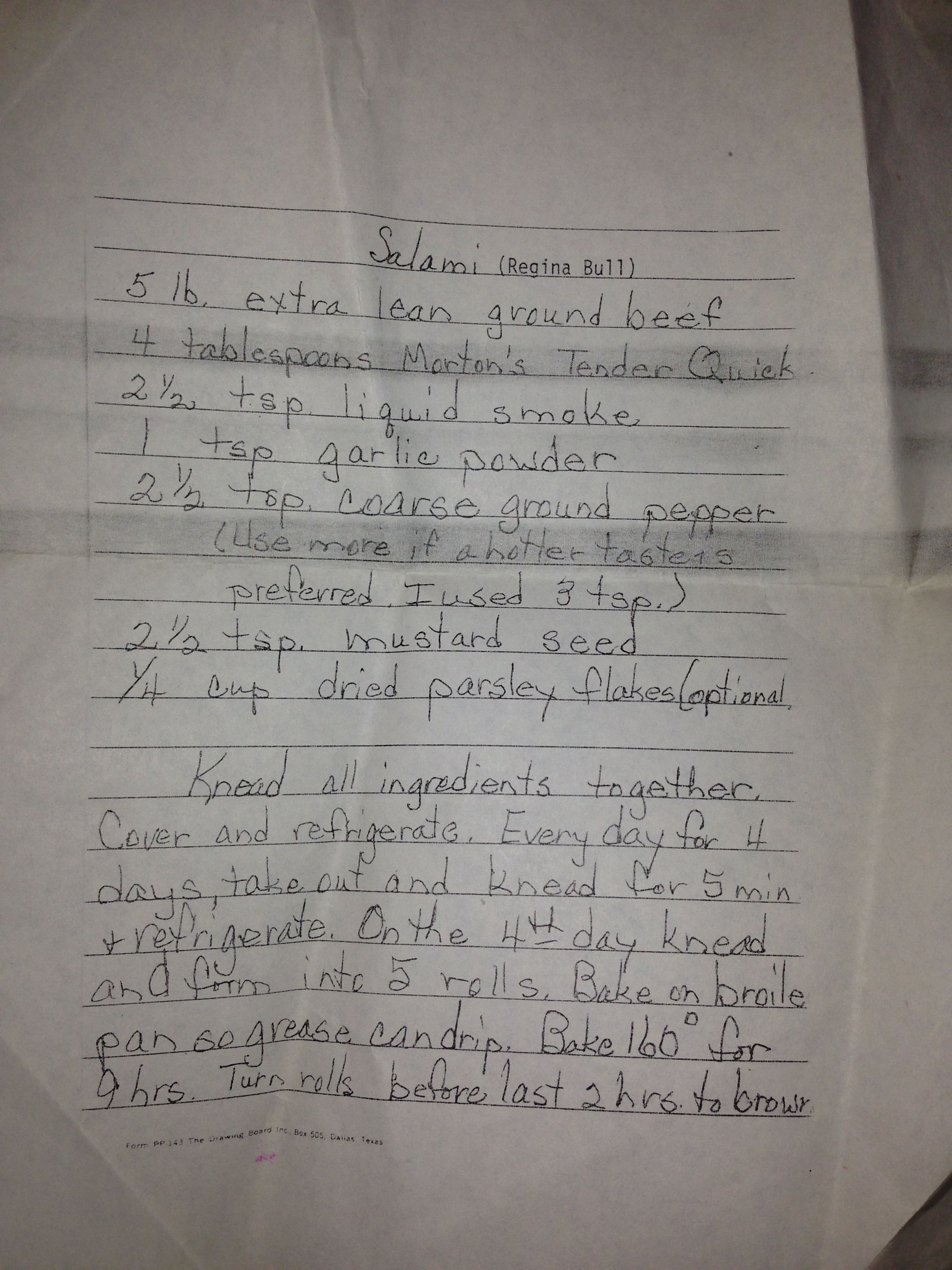
Williams-Sonoma carries pink curing salt, but I’m not sure it’s any different than the Morton Tender-Quick her recipe calls for. All pink cures have the same concentration of sodium nitrite, 6.25 percent, the meat guys say.
Random Thoughts from the Tour Des Fleurs 20K
A boy pulling his fishing net from White Rock Lake is such a joyful sight it will make you crash into your running buddy. A woman running with her dogs behind you is less scary than a pack of schoolteachers running behind you.

You have to add some outs-and-backs to a run around the lake to get the miles in. If you don’t get the out-and-backs lurking around the lovely Lakewood neighborhood, just drive the neighborhood when the race is over instead.
You aren’t wasting your time wishing for good weather in Texas if she dishes up sunny, dry and 65 degrees. Weed-whacking the lake’s edge waits for no one.
Two years of training for long races makes for a deeper level of mental toughness, but you gotta stop and look at the pumpkin houses anyways.
Overheard in the Wolfe House #246
Peggy: Well, I’m not sure about these new glasses.
Sam: Yeah, you look pretty funny in them.
Overheard in the Wolfe House #245
Peggy: Should we get Colorado flood relief t-shirts?
Sam: Oh, yes.