

problem-solving
Not remedial, but cutting edge.
About a month ago, a television reporter went to elementary school classrooms around these parts to tell us about “wiggle chairs.” The chairs helped first- and second-graders sit at their table and get their work done.
I recognized them instantly. When Sam was in elementary school, he went to the occupational therapy lab once a week at Texas Woman’s University. Students worked with him under the supervision of one of the professors. The students from that first semester (fall 1993) was incredibly sweet. The two students were so excited to be working with Sam (first, autism was rarer back then, and they were clearly helping him a lot) that they made him part of their project in another class, too. They built him a t-stool and gave it to him at the end of the semester.
When I first saw it, I couldn’t imagine how anyone could sit on it. We humans are bipeds. How a person can ride a unicycle or travel down the sidewalk on a pogo stick? Just watching makes me tilt slightly to one side.
Sam didn’t use the t-stool a lot, but I did from time to time, in front of television, for example. Your legs help turn the stool into a tripod. That was the point. You wobbled and wiggled your way to stability.
Of course, the concept went mainstream, although the wiggle chairs they are making for elementary school kids are a little better anchored. You could fall over while sitting on that t-stool if you didn’t pay attention (that’s the point). Most kids bounce. But sometimes they don’t.
This isn’t the first time a therapeutic tool like that has gone mainstream. For example, my former aerobics instructor marveled once during a lunch hour workout that many of the tools our class used (steps, balls, slides, rubber bands) were once physical therapy tools. We should pay close attention the next time one of us was injured and used something new in therapy, she said, joking that we could get rich turning it into a workout routine.
It’s a thing, y’all. Pay close attention to whatever techniques or tool special education teachers and therapists are using. Chances are it’s something cutting edge, and in a year or two, all the teachers will be doing it.
Making of a recipe (Raspberry Scones)
When I stop to think how far Sam has come, not just since he was a child, but even his first few semesters of college, I am awed. During these past 10 years of adult life, he’s met tough challenges head on and showed that he can think on his feet. He does so well that I sometimes forget the creative problem-solving skills that flow so easily through the rest of the family aren’t really at his command.
Enter the raspberry scone challenge.
Sam really likes raspberries. Sam is also the family scone and kolache baker. We tried to adapt a peach scone recipe from one of our favorite baking cookbooks, The Pastry Queen. The raspberry scones were a mess. (But we still ate them.)
I had a flash. There was another recipe in the King Arthur Whole Grain Baking cookbook that had a cinnamon-stuffed scone. I told Sam we could mash the two recipes together to help our idea turn out.
It worked, but I made the mistake of not communicating out loud and in advance which steps would come from which recipe. Sam retreated to the laundry room several times during the creation of these beauties to talk himself out of being upset with me (which I appreciate).
I don’t have the explanatory gifts of Julia Child, nor the exacting thoroughness of Coach In the Kitchen.
But as you can see, they turned out great. And Sam is happy to share his recipe.
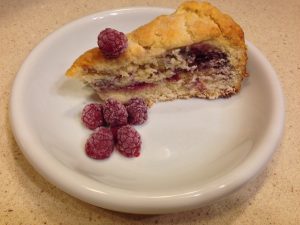
Raspberry scone
Raspberry scones
Equipment: a 9-inch springform pan
6 cups flour
1 1/4 cups sugar
1/4 cup baking powder
1/4 teaspoon salt
1 1/2 cups cold unsalted butter, cut into bits
2 cups buttermilk
3/4 cup raspberry jam
1 cup frozen raspberries
Preheat the oven to 375 degrees. Grease the pan. Stir flour, sugar, powder and salt together. Cut in butter until mixture is crumbly. Fold in buttermilk and stir lightly until it forms a ball. Pat down and fold over once. Divide the ball in half and pat into two discs that fit the pan. Put one dough disc on the bottom, spread with jam and top with berries. Top with the other disc of dough. Cut into 16 wedges. Bake for 40 minutes until knife inserted in center comes out clean. You can brush with milk and sprinkle sugar, if you’d like. Let cool for ten minutes before releasing the side of the pan. Serve warm.
Overheard in the Wolfe House #302
Peggy: How was it this afternoon with the puppy?
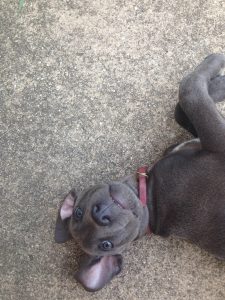
Fang, May 2016
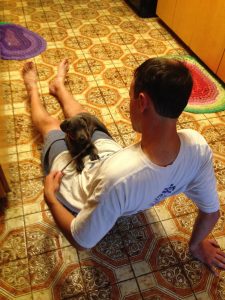
Sam and Fang
Sam (silently shaking his head): . . . .
Peggy: Oh no. Did he have a bad day?
Sam (still shaking his head): Oh, there are good things about him.
The little things, again
Yesterday Sam and I went to a funeral. They are always hard on us, and this one underscored both the hope and the cruelty that comes in the march of time.
When it was time to go, Sam came out of his apartment clutching a tie he’d gotten from his brother, Michael. I didn’t consider it the best match for the shirt he was wearing, but it was acceptable. He needed my help putting it on. He’s always needed my help knotting his ties.
Before I even thought about it, I blurted, “I won’t be able to do this as well as Michael.”
Michael visited a month ago, when Sam rode both English and Western in an able-bodied horse show organized by North Central Texas College. When it was time to knot his tie, Michael helped him with a beautiful, neat knot that I knew he didn’t learn at home.
He was in the middle of his junior year in high school when Mark died. He went off to college at Texas Christian University knowing a lot of things about how to take care of himself. But he never learned to knot his ties other than the simple way I faked up trying to help my boys look good. He wasn’t going to get away with that at such a prestigious school.
Michael said he watched lots of YouTube videos to learn how to knot his ties.
I wish I knew why the little things always break my heart.
Riding Western
Sam competed for the first time in Western style horseback riding at the North Central Texas College stock show last weekend in Gainesville. He competes with “able-bodied” riders from time to time to challenge himself. This was great practice for next weekend. The regional equestrian Special Olympics are being hosted by the stables where he rides, Born 2 Be, in Aubrey.
His coaches have been encouraging Sam to ride Western for a while. Sometimes it takes Sam a little bit to warm up to an idea. He put jeans on for the first time in about 20 years when he tried on a new pair of Wranglers at Weldon’s Saddle Shop last week. (Like his great-grandfather, whom he was named for, Sam’s a khakis man.) Kippie helped him look good, although it’s a mystery where those most excellent chaps came from. Sam says they were, like lots of gear, donated to the stables.
Enjoy.
Catching
Sam has a certain smile that really sings.
He’s such a deep thinker that we don’t get to see this smile very much. Like the smile-for-the-camera smile most of us have, his face looks posed in photographs, only more so. But when a happy moment comes — like that moment when sunlight makes it through the clouds and trees all the way down to the ground to light a patch of wildflowers — Sam’s smile just sparkles.
He lit up that way yesterday when I showed him the rain barrel I brought home from a workshop. “We’re bringing the farm,” he said.
Well, almost. This is the barrel.
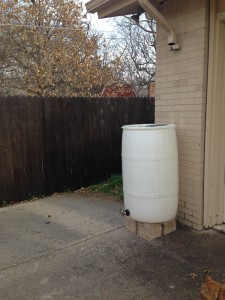
This was the farm’s.
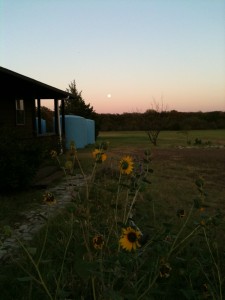
We are growing vegetables in beds on the other side of the fence. That 50-gallon barrel should go a long way toward keeping things watered.
I’ll be writing about the rainwater catchment class and the barrel for Monday’s paper.
We have settled into the new place here in town pretty well. We enjoy the many and varied offerings that come with city life. We’ve all got bicycles and ride them around town more and more. But it’s not the same as life on the farm.
We made a very intentional choice to look around at what was missing and bring it in. The rain barrels, and living life closer to the rhythm of the seasons is part of that.
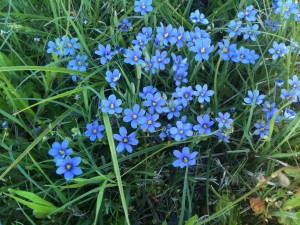
When you see blue-eyed grass covering our front lawn in the spring, you’ll know we finally got it as close as we could.
Chisholm Challenge 2016: Showmanship
Sam says the last pivot in front of the judge didn’t go well. The horse, Rosalie, had “her own ideas.”
Guest blog: Sam on tackling trail gates
Today, Sam finished Chisholm Challenge, a horse show hosted for the past 13 years by the Fort Worth Stock Show and area stables that serve riders who are veterans or have disabilities.
Sam didn’t want to talk much about how the trail ride went. (Hint: Not every kernel popped, either today or yesterday.) He did have thoughts about tackling the gate at the end of the trail ride. (Another hint: the gate isn’t a real gate, it’s a rope representing a gate.)
Sam had to both open and close the gate while remaining on his horse, Rosalie. (Yet another hint: This is so difficult that riders at lower levels may be required only to “open” the gate.) Many times, a rider drops the rope before completing the task.
The rules allow them to pick up the rope and try again, at least a few more times. But many riders, once they have dropped rope, simply give up and end the ride.
Sam says he has been thinking about the gate for many years. Here is his advice to riders who are thinking about giving up:
Independent riders should consider a few more attempts to close the gate if dropped. All they need to do is walk the horse up to the side of the gate where the rope still hangs down, haul up the rope without taking it off the gate, then bring the horse to the other side with the rope in hand and finally … CLOSE THE GATE!
As you can see from Sam’s ride today, a little planning, determination and positive thinking goes a long way:
Sustainability
Earlier this fall, I was able to spend some time with a local biologist studying quail. I learned more in the course of that day than I was able to put in my newspaper story, which often happens.
The biologist has been working with area ranchers on ways to keep the prairie vital both for their cattle and the quail. On the drive back from Clay County, I saw all the ranches in new ways. Some looked like the ranch we had just visited, lush and vibrant. Others looked used up. I smiled to myself about our farm. When we sold it, our place looked like the former, not the latter.
The biologist started telling me a story about how he’d approached one rancher to bring his land into the quail “corridor.” The rancher agreed, but on one condition: it couldn’t cost him any money.
I could tell the biologist planned on telling me this story a certain way. After all, he was trying to build a big research program and do this good thing for the environment. He needed money for his labs and the students helping with the research. They were bringing new and important scientific knowledge where it was badly needed. The reality likely was this: a rancher that needs to make a change after doing things a certain way for years and years probably needs to spend a little money to get it back right.
Before the biologist got to the big finish in his story about the rancher, I blurted out, “so, really, he asked that whatever you proposed for his ranch be truly sustainable. Because for the changes to last, they can’t keep costing him money, right?”
(This is why people don’t invite me to dinner parties. I’m impertinent. I ask questions that stop the conversation.)
The biologist finished his story, telling me that it took awhile to make the changes to help the quail and figure out the true costs, but ultimately, the rancher didn’t lose any money running his cattle that year. The biologist had delighted in the discovery. But, I could tell by the many long and thoughtful pauses that came after I asked my question that he hadn’t thought about the sustainability of his quail program that way.
We didn’t farm our place with some lofty, progressive, green ideal of it being “sustainable.” We just knew we didn’t have any money and that anything we did needed to be harnessing and directing the little energy we, or the land, already had.
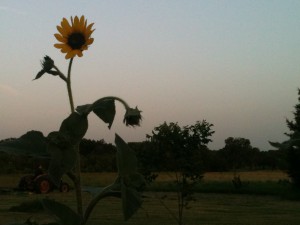
Late summer on the farm
When we tried to help Sam learn to talk and become the marvelous person he was to become, we tried not to focus on hoarding resources. We just tried to harness and better direct the energy we, and he, already had. It worked pretty well.
Sustainability. Its a powerful word. We are starting to use it a lot. I’m not going to let it lose its meaning for me.
Smart thermostats anywhere
By Sam Wolfe, Guest Blogger
According to the recently published news story, “Smart thermostats remember for you,” a thermostat that is “just about as smart but doesn’t connect to the Internet” was installed in the back side of this home. (We live in northwestern Denton.)
Only one wire was available to power the thermostat. According to HVAC technician Bill Clark, the thermostat pictured in this story needs two wires to operate, a hot wire and a common wire, as do all other smart thermostats you can buy.
Research shows that the common wire is not available in some applications with a non-heat pump system. This requires battery power to a digital thermostat. Only a conventional thermostat or a programmable thermostat (one that is “just about as smart but doesn’t connect to the Internet”) could be used in these applications … until now.
With a Venstar Add-a-Wire accessory box and diode, you can simply “turn one wire into two.” For more information about this accessory, follow this link:

thermostat in back of house
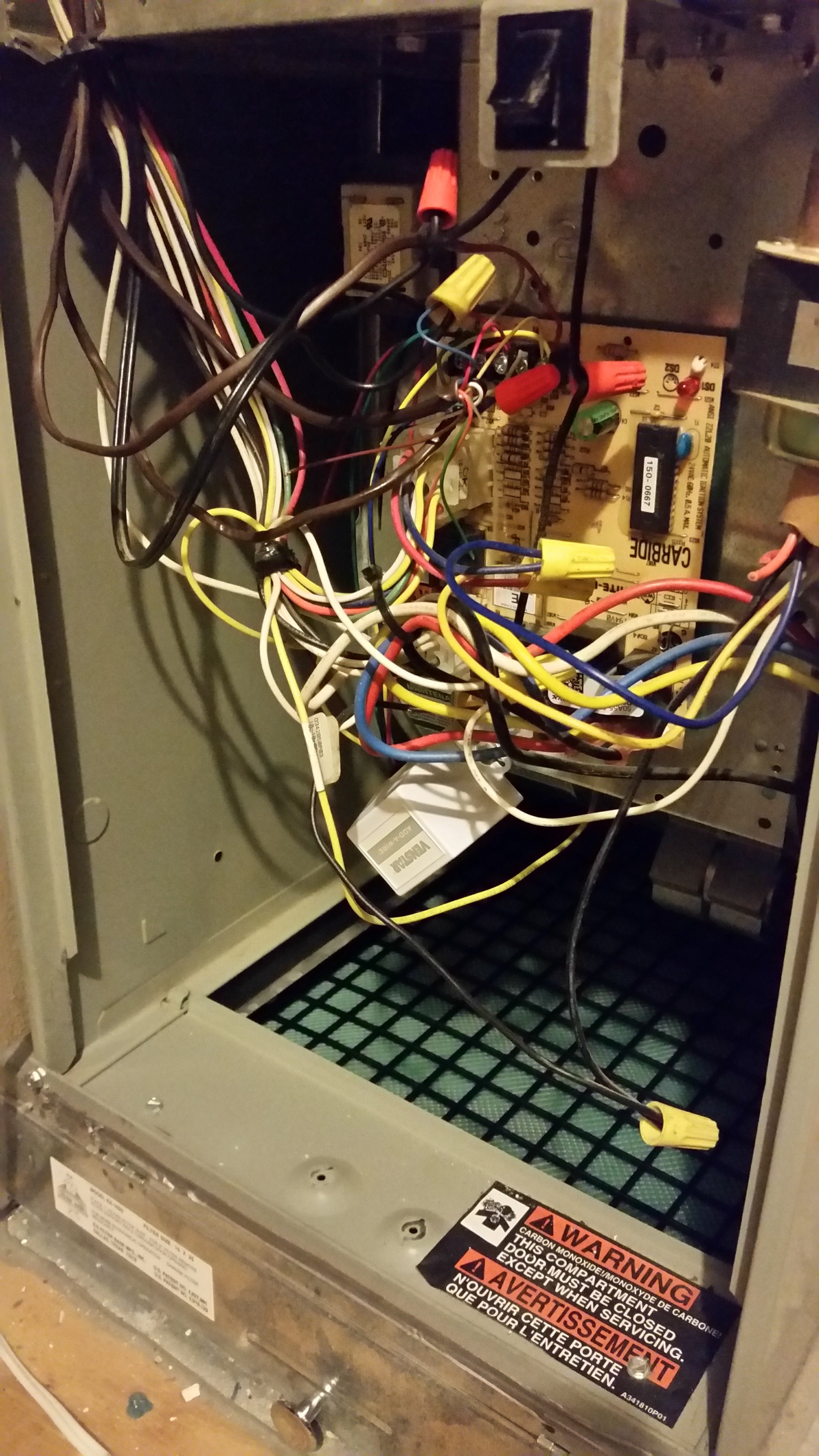
accessory box installed in furnace
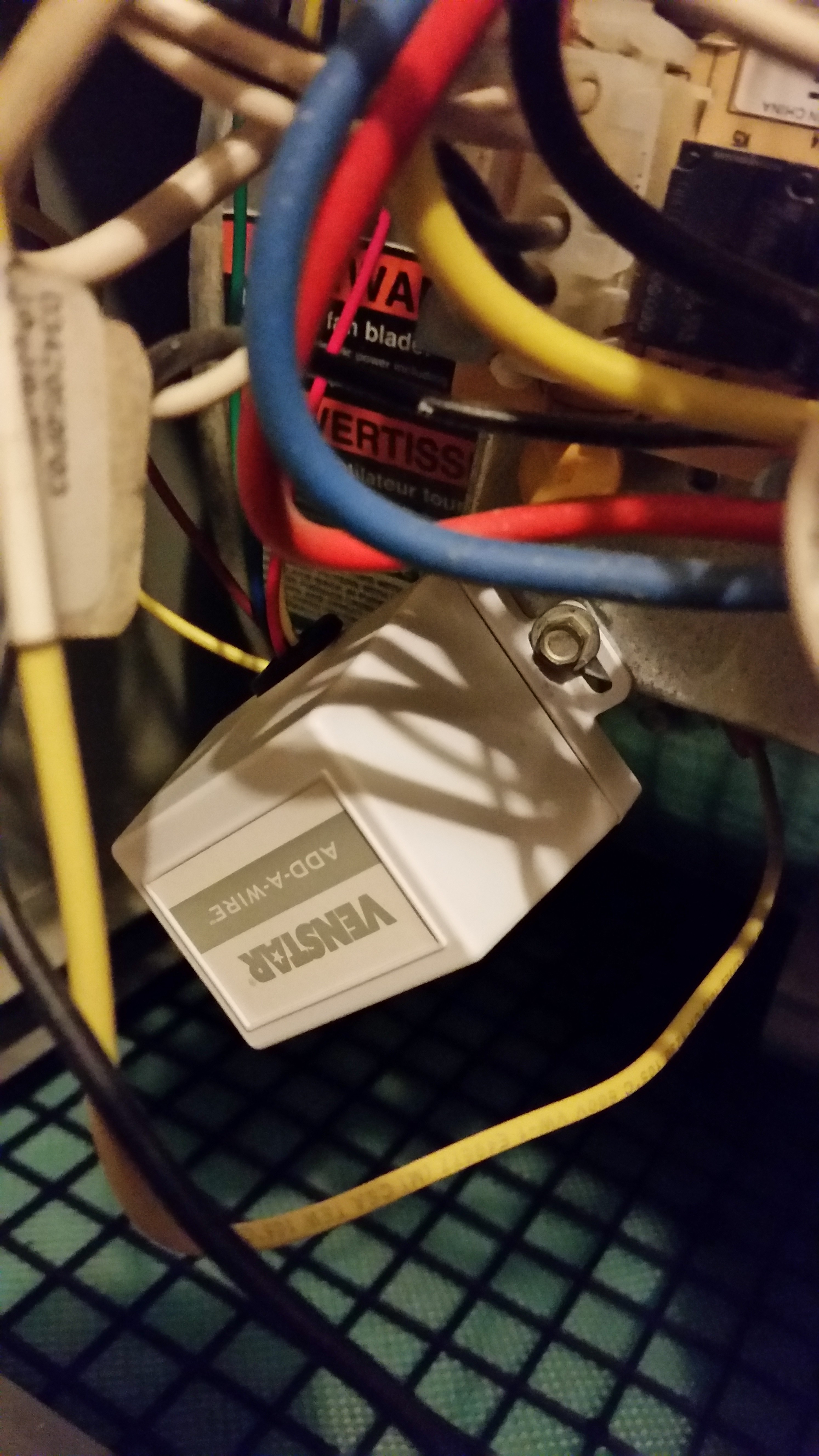
close-up view of accessory box
Note from Peggy: Sam was terribly disappointed after we were able to install an internet-ready thermostat in my house, but not his apartment. (For want of that wire. I wasn’t going to pay to lay more wire in the attic.) He went in search of a solution to that problem and found the add-a-wire device. After I asked him to make sure it was UL-listed, he ordered it, and then installed both the add-a-wire and the internet-ready thermostat in his apartment (which is in the back of the house) himself. He took the photos of his handiwork so you can see what he did.