

What Sam says
Whether to disclose
As part of their initial job training two years ago, Sam and his cohort at the WinCo warehouse received important information about when, or whether, to disclose their disability to others.
We didn’t give a lot of thought to this issue before sending Sam out into the world. We had always treated it as a need-to-know basis. Not surprisingly, outside of school and the workplace, most people don’t need to know.
The Texas Legislature passed a law effective this month that lets people with autism and other disabilities who drive to privately disclose their disability so the information comes up with their license plate. That way, a police officer or highway patrol officer knows there may be some communication challenges ahead and to take their time.
Other public encounters can benefit from some level of disclosure. On both of our cycling vacations, we didn’t lead our ice-breakers with any kind of disclosure. But our tour leaders and fellow cyclists soon figured out Sam’s autism. They watched what we did to accommodate him and followed suit. In Germany, it became a running joke with one woman that Sam tried more new foods than her persnickety husband did. We fielded a few questions on the side, but our travel companions were simply curious about our family; they weren’t prying.
One of the lessons Sam and his cohort learned during initial training was that disclosing your disability often isn’t necessary and that it also comes with some risk. “People can take advantage of you,” Sam told me. Sam’s rather risk-averse, so he’s not inclined to disclose and we’re happy to follow his lead.
The other night, I shared a travel horror story from one of my recent trips, in hopes that he might benefit from my experience. I thought if he ever got patted down, he should disclose his disability to the TSA agents.
In my latest travels, the screening machine flagged my underwire bra. I was upset that they intended to pat down my side. I insisted on a private screening, which really bugged them and the passengers behind me. The twenty-something girl behind me was obviously panicked about missing her flight. Magically, they flagged her every limb, and her crotch, and she let them pat her down everywhere, all the while she fussed at me for not complying. I was sad for her.
Sam said he’s never been patted down at the airport. (I’m patted down Every. Single. Time. Don’t tell me it’s random.) But he had one of his own air travel horror stories that he had not told me about before.
He was in line to board the plane when the crew announced that they were going to do a bag search at the gate. Sam was caught off-guard, as I’m sure many other travelers were. (Perhaps, dear internet readers, you know what that is about and can explain in the comments below. We could only guess what it was about.) He wasn’t able to re-pack his bag quickly and other travelers were getting impatient with him. That, of course, unnerved him even more and made it harder still for him to recombobulate. A gate attendant finally had to help him.
I told him that might have been a good time to disclose his autism–not to the impatient people around him, but to the gate attendant who was helping him. I said most people might not understand why you need more time because autism is a hidden disability. They might even be embarrassed at their ignorance and impatience for not recognizing it themselves, I said, because most people are good and want to be kind to others. I told him that as you disclose to the gate attendant, the angry people would overhear it and probably change their behavior toward you, unless they are are real jerks.
Sam disagreed that it would have been a good idea to disclose, and that is his prerogative. It’s not his job to help the world not be a jerk.
Overheard in the Wolfe House #319
Peggy (sneezes loudly)
Sam: Sa – lu – te!
Peggy (laughing): Grazie.
Sam: Prego. (pauses). I had to do that. That [sneeze] was … impressive.
Overheard in the Wolfe House #318
Peggy (several hours after dropping the dog off at doggie day care): Gosh, I miss Fang.
Sam: When are you going to stop saying that?
Overheard in the Wolfe House #317
Sam: After we go to Italy, I might not want to ever come back.
Peggy: That would not surprise me.
Overheard in the Wolfe House #316
Sam: What’s an ‘old-timer’?
Peggy: I think different people might use that label to describe different things. What do you think it means, Sam?
Sam: Someone who doesn’t use new technology.
Peggy: Oh yeah?
Sam: And someone who talks about the old days.
Peggy: Then I guess I’m not an old timer.
Sam: Really?
Overheard in the Wolfe House #315
Peggy: Do you have yellow lenses for your bike glasses?
Sam: What are those?
Peggy: Try mine and see.
Sam (squinting out the window at the overcast sky): It’s sunny.
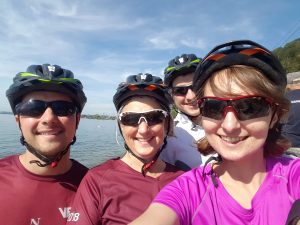
Sam, myself, Michael and Paige on the Lake Constance bike trail from Bregenz, Austria, to Lindau, Germany.
Overheard in the Wolfe House #314
Peggy: That box on the front seat of your car is all your old ribbons to take to Mary’s office next time you ride at Born2Be. They can reuse them.
Sam: Yeah, Mom, it takes more than a ribbon to prove your success.
#RealMillennial
Stupid fear
Sam almost didn’t get to go to the State Fair of Texas this year. I enjoy the fair but, honestly, I wouldn’t miss it if a year or two went by without a trip.
I think Sam likes that every time we go we check out something new, but we also do some of the same things: have a Fletcher’s corn dog, ride the carousel, stop by the show barn to see a hundred different kinds of rabbits or goats or whatever is running that weekend, sit on a tractor and remember the days on the farm.
Michael and his fiancee, Holly, came up from Austin to go to the fair last weekend, so Sam had a chance to go. I told Michael to be sure to take Sam by the auto show and have him get behind the wheel of a Chevy Bolt. Mission accomplished there. Sam’s going to be buying a new car in a few years and he needs lots of opportunities to switch from abstract and into concrete ways of thinking about that.
One thing that hasn’t been predictable about going to the fair is the train ride. Sam likes taking rail to the fair. It would seem predictable, but it’s not. Denton’s A-train shuts down early on Saturdays. Dallas runs extra DART trains on unpublished schedules for fair crowds. Michael and Holly planned to drive home to Austin from the fair. They were having fun and wanted to stay past the last train home to Denton, so I agreed to pick Sam up at the end of DART’s green line in Carrollton.
Sam got on a run that wasn’t on the posted schedule. He had to get off several stations early and wait for another train. He called Michael and then called me. Michael was unnerved. He didn’t know why Sam got off the train, he just knew someone “told him” to get off. Michael called me. Was Sam in trouble? Was he being bullied? Was he ok? I got a key piece of information from Sam: it was the end of the line for that special run. Sam was ok.
On the drive back to Denton, I told Sam it’s important sometimes to tell people why something was happening. Not knowing the “why” can lead to worries.
For a while, our conversation went on a tangent about worst case scenarios for being bullied on the train, for which Sam already had a good plan. He’s been bullied enough in his life that he knows to prepare or troubleshoot, and that’s just heart-breaking.
Then we switched to talking about taking the perspective of others. Sam knows that people are sometimes scared of him because he’s different.
I asked, but he had forgotten when that had happened to him back at North Central Texas College. A female classmate befriended him over several weeks and then freaked out when he asked her if she wanted to go get some lunch. (Isn’t that what college friends do? Or have times changed that much?) A school official told Sam that the classmate came to them for help. They told him to stay away from her. I was stunned that they viewed her as more vulnerable than him. I still am.
And yet, this is what he said about riding the train, or hanging with friends, or otherwise being out in public:
“I don’t ever want someone to be afraid of me.”
America, you might work on that. You are really stupid afraid these days.
No going back
Sam lost his sunglasses in Germany.
There wasn’t anything remarkable about the sunglasses themselves. They were a pair of sunglasses that had been lying around the house for years, a little scratched, but durable both in their purpose and their terrific ability to avoid getting lost the way most sunglasses do.
Sam, myself, Michael and Paige on the Lake Constance bike trail from Bregenz, Austria, to Lindau, Germany.
The loss, though, became a valuable lesson for our family.
I knew the trip would challenge us, biking more than 150 kilometers over the course of five days. At the end of the first day’s two-hour ride, Sam turned to us and said he was confident that he had trained enough for the trip.
He had been a little nervous about it, but we set out on hourlong rides several times a week in the months before. Inspired by Michael, he also hooked his bike up to a wind trainer for regular spins.
The third day, our second full day of riding, set out as our longest ride of the week. We left our hotel in Lindau to cycle to our next hotel in Uberlingen. Most of the people in the riding group took the shortcut, taking the ferry from Friedrichshafen to Meersburg to finish the ride. We met the group and told the tour leaders that we wanted to cycle through the orchards and vineyards rather than ride the ferry.
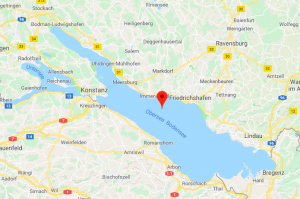
Lake Constance
About halfway to Meersburg, we stopped to refill our water bottles and have a snack. Sam asked where his sunglasses were. He thought someone had grabbed them for him in Friedrichshafen, where we all took a bathroom break.
No one had. Sam asked if we could go back and get them. Michael told him, “Sam, there’s no going back. We’re already pretty far from Friedrichshafen, and we’re riding 40 kilometers today.”
Sam protested briefly, but got back on his bike and plowed ahead. When we arrived at Meersburg for lunch, he was still upset. We sat at a table beside the lake and Sam tried to explain. It wasn’t going well and people were starting to stare. I invited Sam to take a walk with me to the water’s edge so he could collect his thoughts and I could make more room for listening.
There was another family walking on the little beach with their German shepherd. They threw sticks into the waves. The dog wouldn’t venture past depths over its head, but it worked hard to bring back every throw.
Eventually, Sam was able to collect his thoughts.
He understood that sometimes we help him out as a trade-off, to get things moving faster, especially when being slow is risky. But when he is responsible for himself, “I need more time,” he said. And he said that it was clear to him on this type of excursion, a person has to be responsible for themselves.
Most of us human beings don’t have enough self-awareness to assess these kinds of scenarios, let alone ask simply and directly for the fix. Sam constantly amazes me with this gift of his.
We went back to the table and announced the findings. We all agreed we could and should slow down our transitions. Paige asked Sam about a checklist. What if each of us went through a checklist, like an airline pilot, before we cycled on? The process helped us slow down for Sam and, at one point, also kept me from losing my cycling gloves. We often were the last ones of the cycling group to leave, but because we rode fast, it all worked out in the end.
I told Paige later that day that I did have a secret hope that the trip would stretch the family, although I wasn’t quite sure how. I hoped we wouldn’t be miserable, but I didn’t worry about it either.
Learned helplessness does someone like Sam no service at all, and some of that was coming from our habits to take shortcuts and speed things up. He deserved more from us. We learned we could step back, let some conflict points rise up and not freak out. After all, Sam is a grown-ass man.
Overheard in the Wolfe House #313
Peggy: You’ve got to keep your boundaries.
Sam (talking about girl trouble): I have really strong boundaries, but she’s put a chink in all of them.