

Posts by Peggy
Whether to disclose
As part of their initial job training two years ago, Sam and his cohort at the WinCo warehouse received important information about when, or whether, to disclose their disability to others.
We didn’t give a lot of thought to this issue before sending Sam out into the world. We had always treated it as a need-to-know basis. Not surprisingly, outside of school and the workplace, most people don’t need to know.
The Texas Legislature passed a law effective this month that lets people with autism and other disabilities who drive to privately disclose their disability so the information comes up with their license plate. That way, a police officer or highway patrol officer knows there may be some communication challenges ahead and to take their time.
Other public encounters can benefit from some level of disclosure. On both of our cycling vacations, we didn’t lead our ice-breakers with any kind of disclosure. But our tour leaders and fellow cyclists soon figured out Sam’s autism. They watched what we did to accommodate him and followed suit. In Germany, it became a running joke with one woman that Sam tried more new foods than her persnickety husband did. We fielded a few questions on the side, but our travel companions were simply curious about our family; they weren’t prying.
One of the lessons Sam and his cohort learned during initial training was that disclosing your disability often isn’t necessary and that it also comes with some risk. “People can take advantage of you,” Sam told me. Sam’s rather risk-averse, so he’s not inclined to disclose and we’re happy to follow his lead.
The other night, I shared a travel horror story from one of my recent trips, in hopes that he might benefit from my experience. I thought if he ever got patted down, he should disclose his disability to the TSA agents.
In my latest travels, the screening machine flagged my underwire bra. I was upset that they intended to pat down my side. I insisted on a private screening, which really bugged them and the passengers behind me. The twenty-something girl behind me was obviously panicked about missing her flight. Magically, they flagged her every limb, and her crotch, and she let them pat her down everywhere, all the while she fussed at me for not complying. I was sad for her.
Sam said he’s never been patted down at the airport. (I’m patted down Every. Single. Time. Don’t tell me it’s random.) But he had one of his own air travel horror stories that he had not told me about before.
He was in line to board the plane when the crew announced that they were going to do a bag search at the gate. Sam was caught off-guard, as I’m sure many other travelers were. (Perhaps, dear internet readers, you know what that is about and can explain in the comments below. We could only guess what it was about.) He wasn’t able to re-pack his bag quickly and other travelers were getting impatient with him. That, of course, unnerved him even more and made it harder still for him to recombobulate. A gate attendant finally had to help him.
I told him that might have been a good time to disclose his autism–not to the impatient people around him, but to the gate attendant who was helping him. I said most people might not understand why you need more time because autism is a hidden disability. They might even be embarrassed at their ignorance and impatience for not recognizing it themselves, I said, because most people are good and want to be kind to others. I told him that as you disclose to the gate attendant, the angry people would overhear it and probably change their behavior toward you, unless they are are real jerks.
Sam disagreed that it would have been a good idea to disclose, and that is his prerogative. It’s not his job to help the world not be a jerk.
How to raise a hater
Three years ago, I saw a window into how you raise a hater. It was at, of all places, the movies.
I talked with my daughter, Paige, about it. She was there. She didn’t hear what I did, but she heard something else like it. I shared my experience and insight with Shahla. She encouraged me to blog about it, but the words got stuck. A lot.
When the world is full of haters, it’s not a good place for Sam and people like him, who need us to be our best selves. People are loving and generous for the most part, but I’ve seen the dark side, too. It’s easy to feel noble and loving and generous when it doesn’t really cost you.
After a white boy drove to El Paso in order to shoot innocent people yesterday, the words finally started to flow. We talk about preparing for mass shootings in the newsroom. We know we must. There’s nothing about our community that’s special. The haters are here.
Three years ago, I watched a father teach his son how to be a hater.
Oh, it wasn’t obvious. The boy didn’t even know he was being taught to be a hater. And the father didn’t know he was teaching it, either.
To get passed down, these things have to go slow. A father loves his son and wants to be loved by his son.
A trailer played for Hidden Figures, the movie based the early days of NASA and the first flight to the moon. I sat next to the father in the movie theater. The trailer made him uncomfortable. In between stunning images of rockets blasting through space, hints of the little-told story about the pivotal role that black women played in the program unfolded. He could bear it no longer. He leaned over to his son, who was probably 8 or 9 years old, and said, “We won’t be seeing that.”
I knew why he was uncomfortable. But his son didn’t. After all the previews played, the father said, “There are lots of good movies to see.” And the son added, “But not that space movie.”
A boy loves his father and wants to be loved by his father.
We were all there to watch Moana. Did the father not know what this Polynesian legend was about? Apparently not, Paige said, because after the movie he kept asking his wife: but where did they come from?
The father had too much discomfort. A family has to find a place for the discomfort when father is afraid. The needs of the one outweigh the needs of the many. To get passed down, these things have to go slow.
Our kids will do things, learn things, seek things that make us uncomfortable. We have to let them. They will still love us. They are becoming their own. They want, and can, do like we did when we were young, and make the world a little better than it was before. If we don’t let them, they won’t be resilient enough to survive all these changes. They will become a snowflake.
Or worse.
A hater.
Fare thee well, feline
It’s been ten days since we’ve seen our cat, Tiger, although I knew the first morning when I opened the back door and he didn’t show that he was gone for good.
Tiger came to live with us as an outdoor cat. He was one of several kittens that a co-worker’s wife found in a box on the side of the road fifteen years ago. We were living on the farm at the time and had been having trouble keeping cats, as often happens out in the countryside. But Paige was 10 years old and pining for a cat, so we picked the male orange tabby kitten for good luck.
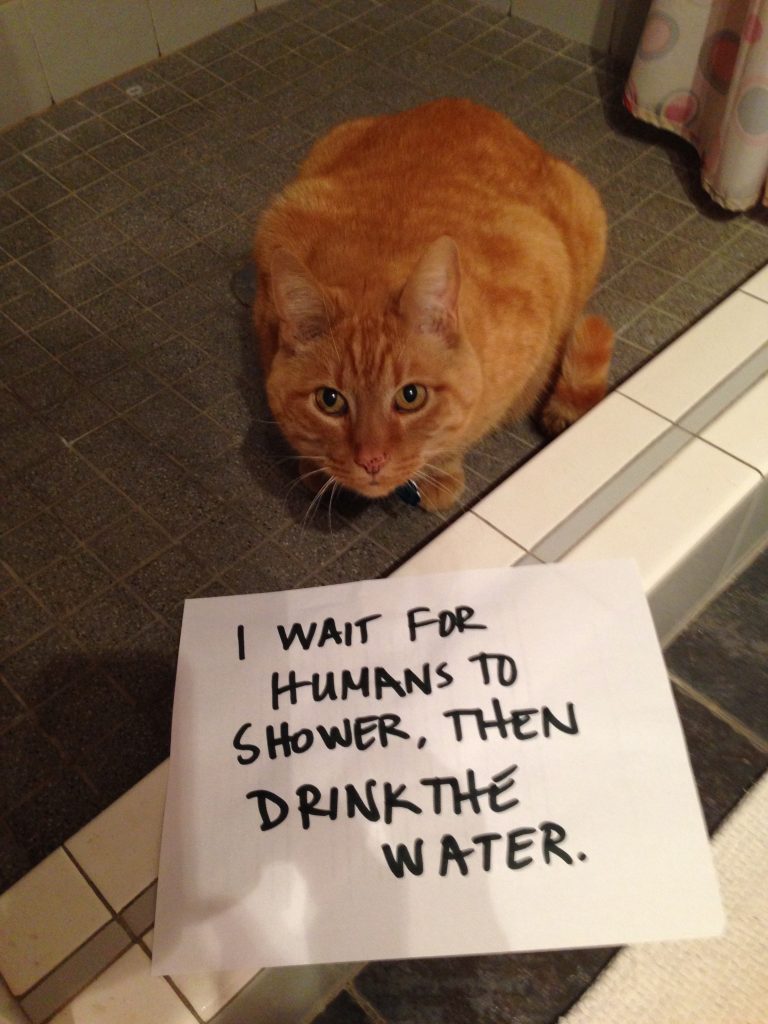
Tiger’s cat-shaming portrait.
Tiger proved to be a survivor. Even as coyotes, owls and other predators exacted their toll on our farm, Tiger knew when to hold ’em and when to fold ’em. When it was time to move into town, I was apprehensive. He’d lived on the farm for more than a decade. I got advice from other cat owners and the veterinarian. On moving day, I was ready with drugs and a crate, but as soon as the moving vans showed up in the driveway, Tiger, ever the survivor, hid out. Two days later, he got hungry enough for the new owner to catch him in the house and call me.
During the transition, he fought against the drugs so it was like having a drunk college student lumbering around the house as we unpacked boxes and filled cupboards and closets and bookshelves. After a week of supervised outdoor time, he started fighting the whole cat-on-a-leash thing. I opened the door and said, “good luck little buddy.” I don’t know what I was worried about. He was a survivor and he knew where he lived. That’s where his food dish is!
Now that he’s gone, I feel the loss, as I knew I would, even though I’ve also known I won’t get any more cats. I’m a dog person. I have been since I was a girl, obsessed with learning all the breeds of dogs and reading stories about dogs and pining for a dog myself.
While our dogs have reminded me of the rewards of loving unconditionally, I have to give props to Tiger, whose utter cat-ness provided insight into life’s more complicated doings and feelings.
He brilliantly established his personal space. Pet him just a stroke or two when he wasn’t feeling it and he bit your hand or arm or leg or foot to let you know. Even when he was willing to sit for a little cuddle time, you still got bit at the end.
He ate ritualistically: every half hour or so, he returned to the bowl to eat several bites. Ergo, we learned to always pause for a moment when we opened the door to let him in (or out) and forever keep kibble in the bowl.
He often joined the dog and I on the first block of a walk. Then he decided either we weren’t worth the effort or going into the wrong territory and he went off on his own.
When Paige went off to college, the cat expressed how distressing the empty nest was by peeing all over the pricey feather bed I bought to deal with a too-hard mattress. I didn’t even try to recover anything. The feather bed got tossed in the trash. I still sleep on that too-hard bed.
Farewell, old friend. We’re glad you came to stay.
Overheard in the Wolfe House #319
Peggy (sneezes loudly)
Sam: Sa – lu – te!
Peggy (laughing): Grazie.
Sam: Prego. (pauses). I had to do that. That [sneeze] was … impressive.
Cycling close to the sun
Sam said he liked the country roads best on our family bicycling trip to southern Italy. There are 60 million olive trees in Italy and I do believe we pedaled past a hefty percentage of them.
In this photo, you can see he stopped next to an olive tree that was a thousand years old. Some of them look great. Others are succumbing to a bacteria that came over with an insect stowed away on South American-made pallets. Many of the olive groves are small, family-owned plots that produce enough to supply the family with a little more to share. (You can buy olive oil in Italy the way we buy craft beer here in the U.S.)
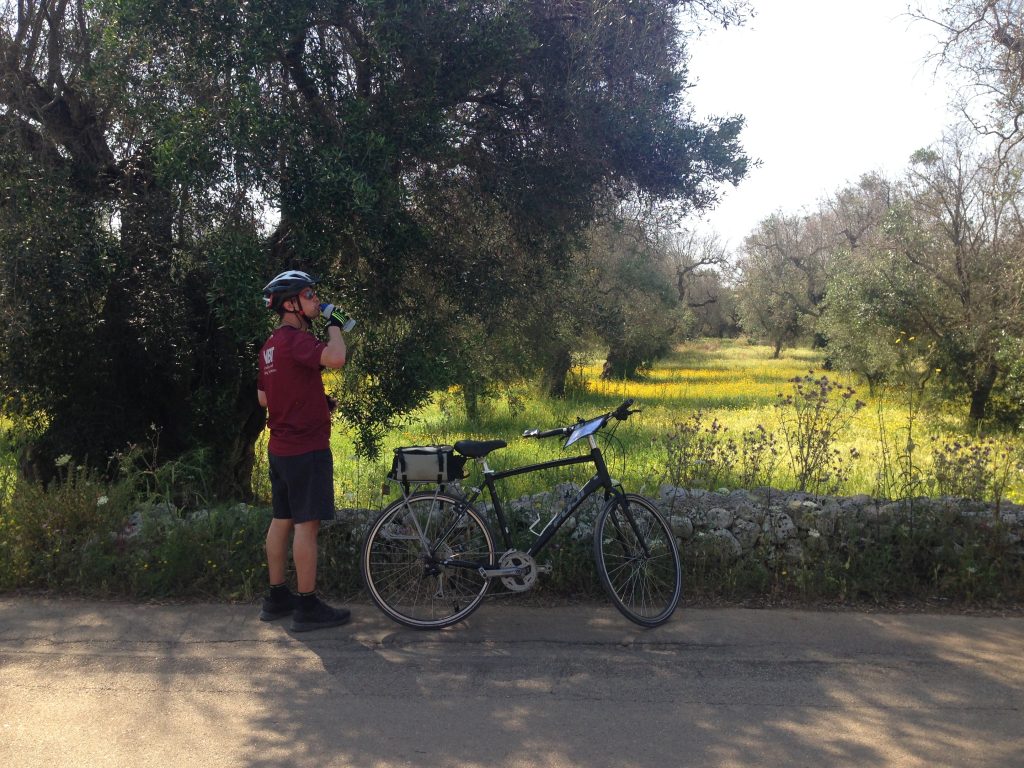
Sam stops for a quick drink during a backroads bicycling trip across southern Italy.
On the backroads, you can trade that ten-European-cities-in-seven-days experience for a different kind of intensity. What’s not to like when you share miles of road lined by stone walls with just the occasional tractor or Italian nonno driving his 1967 Renault Quattro to the village? The roads weren’t perfect, but Sam didn’t mind dodging the potholes. Once, along a highway, I watched him drift, ever so slightly, into the main lane so that he could cycle over the rumble strips.
On the backroads, you can catch the fragrance as you pedal by chamomile, star jasmine, ginesta (broom) or the pine trees.
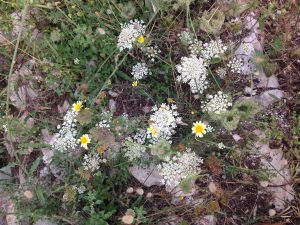
Chamomile and other wildflowers along the backroads of southern Italy.
You can see a farmer having a sandwich in the shade of an olive tree. Another farmer stops picking to pass a handful of fresh figs over the wall to a fellow cyclist. Old men sit on benches in the center of the village and wish you “buongiorno!” The village center doesn’t look like it’s changed much at all in several hundred years.
Sam was ready for the routine, having gone on a similar tour last fall in Germany, Austria and Switzerland. We pedaled a good pace and still found time to relax in the swimming pool after covering 20-30 miles each day. Nobody lost anything along the way. The only real drama came the last day. A driver honked and then turned right in front of Paige, thinking that Paige would stop (uh, NOT) and then nearly hitting her on her bike. One of the tour leaders detoured to yell at the driver. The moment was so quintessentially Italian that I couldn’t help but live vicariously through the movie she was making for me right then and there.
Sam downloaded two dictionaries before we left the U.S. and explored the language often. He always tried to order in Italian. Periodically, he also thought of things that would increase our comfort and success in living out of a suitcase for days at a time. He inspired me to start a new checklist for our next trip — when or wherever that might be. At one point, he told me he thought he could take the next tour by himself.
He probably could, but that was never a goal of these trips. Traveling brings new perspectives. We bring some of the romance home by letting the experience change the shape of our daily lives. Sam grows through travel just like the rest of us, only a little bit more. He has always cycled a little closer to the sun.
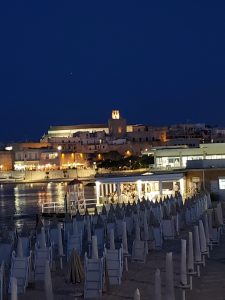
Otranto by night. Photo by Sam Wolfe.
Cake for breakfast
Early on during our bicycle trip in southern Italy, Sam announced a goal: he was going to try all the seafood he could. That was daring.
The first day, our trip leaders asked whether anyone in the group had food allergies or preferences that they needed to know. Sam’s preferences are idiosyncratic, but they aren’t hard to work around. It was easy enough to tell them that for welcome cocktails, “no alcohol, no bubbles” works for Sam. The bartenders seemed to enjoy the challenge putting together fun juice combinations for Sam. He also doesn’t like fresh tomatoes, although tomatoes cooked into sauces are ok. Even so, when something came out of the kitchen with a tomato or two – the Puglia region is famous for its cherry tomatoes – he was a sport about it.
But the seafood goal was something else altogether. The first time I can recall him being deliberately additive, not restrictive, about food. He studied entire menus in his quest. He picked classic Italian dishes: a plate of mussels as a starter, pasta with clam sauce for a first course, a swordfish steak for second. He picked unexpected ones, too, like seafood pizza. He was triumphant when he found octopus and potatoes for dinner at a seaside restaurant in Savalletri.
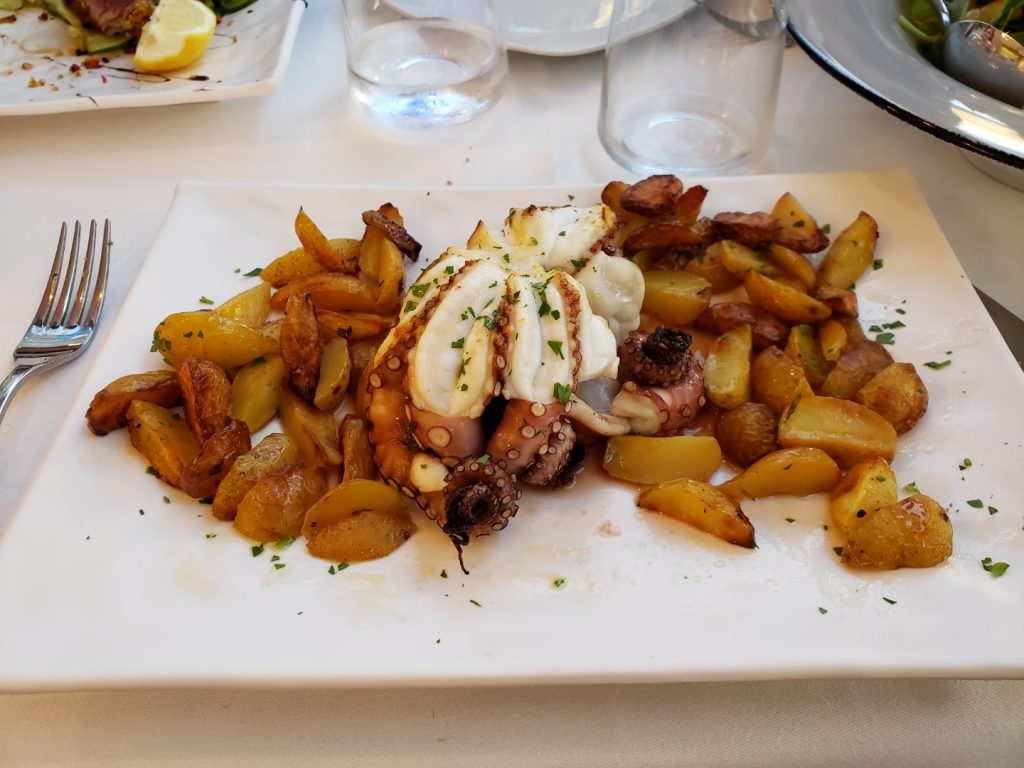
Octopus and potato, a traditional second course in southern Italy’s Puglia region
That’s his photo, by the way.
It’s hard not to be sentimental about how far he’s come. Sam was so food challenged growing up. As a preschooler, he would eat only breakfast cereal morning, noon and night. He hit his big growth spurt at age 15 and even though he was hungry, he limited his food choices and still refused meat. We came close to taking a second mortgage out on the house in order to pay for an intensive intervention program at Ohio State, but he turned a corner just in time. Given enough ketchup and Parmesan cheese, he started broadening his choices. Instead of eating the edge of the bun all around the hamburger, he ate the whole burger.
(Puglia restaurants are surely restocking their Parmesan supply now that we’re back home. But to be fair, he didn’t cover everything in Parmesan. We let him know which Italian foods didn’t lend themselves to that and he was happy to try without.)
Paige and I had our own dining wish lists, although we were never able to make good on eating tiramisu in Italy. The dessert at the end of the meal was usually the chef’s choice. Sweet semifreddi, gorgeous gelatins, mille-feuille — it was hard to get upset about that.
We didn’t expect that the choice of dessert sweets would be plentiful at breakfast, but there you have it. Italian masserias place many different cakes and crostada on their breakfast buffets.
We were cycling 20-30 miles a day. Heck, yeah, we had cake for breakfast.
Overheard in the Wolfe House #318
Peggy (several hours after dropping the dog off at doggie day care): Gosh, I miss Fang.
Sam: When are you going to stop saying that?
Racing alone
Another year of equestrian Special Olympics has come and gone. Sam had an off year this year, I think in part because the regional competition had to be canceled for bad weather. He and his teammates missed some of the momentum needed in competition.
Sam remained a sportsman through the disappointments. I almost thought he wasn’t feeling it – until it was time to head back home. He was sad to leave, saying that we always have fun but the competition wasn’t what he’d hoped for. Then he added that maybe next year he would only do drill.
Sam’s been branching out as a horseman this year. For many years, he only rode English. A few years ago, he added Western events. That opened the door to barrel racing, which is a barrel of fun. This year, he added carriage driving and drill.
Sam picked out the drill music first, which brings its own kind of joy for him. He and Mal, his riding coach and drill partner, did well on their short routine, especially considering how little time they had to practice. Since no one else had a routine with such challenging moves, they were competing against themselves at state Special O. They got gold.
I understood what Sam was saying. He wanted to race alone.
There’s a moving passage in architect Nader Khalili’s memoir, Racing Alone, where he explains his internal transformation, leaving a successful practice as a high-rise architect to develop prototypes for sustainable earth architecture.
Khalili tells the story of watching his son play with his friends. They have a foot race and his son, who is smaller than the other boys, falls behind and loses. Crying, the boy tells his father that he only wants to race alone. Khalili takes his son to a quiet track and watches him, full of joy, run and run.
Our children can be such magical teachers.
Overheard in the Wolfe House #317
Sam: After we go to Italy, I might not want to ever come back.
Peggy: That would not surprise me.
Odd couple
Sam traveled last weekend and the house was a little too quiet without him–a complaint he has made to me when I travel without him.
For four years now, we’ve shared a house as a funny mix of roommates/landlord-tenant, although the mother-son thing can still come into play. I don’t go in his apartment without asking, unless I need do something landlord-ish and he’s gone. We shop and try to do some fun things on the weekend, but go our separate ways socially, too. He uses the common spaces of the house like a roommate would, taking care of his own laundry and cooking. He leaves my things and my private spaces alone, which really isn’t something you worry about until you’ve had a roommate who eats your secret stash of Thin Mints and shops your closets.
When the mother-son thing does happen, I try to imagine what I would do for Michael or Paige and try not to do any more than that for Sam, except be a really good explain-i-ologist. He still needs that and always will.
He called home while he was gone this weekend. I didn’t expect the call, but my big fat grin told me how much I missed his company and I told him so. He said he missed me, too.
We’ve made a different kind of family, Sam and I. And I don’t know why, but I’m imagining filling out the census at this time next year and thinking about how we’ll be counted as one of those different kinds of families, and how important it is for all the families who have adult children with autism to get counted.
Years ago, I stumbled over a spot in one of Jill Connor Browne’s Sweet Potato Queen books where she recommends the five kinds of men you simply have to have in your life.
Where am I going with this, you ask? Please bear with me. If I had days to write you a better transition, dear Internet people, I would have. Ok with the bumpy transition, you say, so back to what you were saying about these five types of fellas …. ?
Well, the shorthand version is every gal needs a sugar daddy, a dance partner, a handyman, a lover and a soulmate. You can’t get all that in one fella, says those Sweet Potato Queens. Maybe you’ll get lucky and marry someone who ticks a lot of those boxes, but you’ll still need to set about lining up the rest of the fellas in your life one way or another.
It’s silly really, but I found it great fun to tease friends about it and a nice way to brag how Mark did pretty well with the last three. After he died, it was hard to tease about it and I can’t remember, honestly, the last time I did.
But when I think about how much Sam has grown, that funny idea creeps back in my head. Sam is definitely a handyman, almost better than Mark at this point with anything electrical or HVAC or plumbing in the house. And he’s a great dance partner; although not for me so much, because, as Dad is fond of saying, hugging family is like touching a hot stove to Sam. But we’ve two-stepped together and I’m sure we will again at the state Special Olympics dance and at Michael’s and Holly’s wedding.
And Sam is a different kind of soulmate, at least to me. I don’t know if I am to him, that’s for him to say. But he has a way of seeing the world that forces me to ask whether I’m being my best self, and in a nonjudgmental yet unyielding way that’s good for my soul.
It’s love and family, after all.