

Overheard in the Wolfe House #303
Peggy: So how was horseback riding today? Were you back on Revenue?
Sam: Yep, back on Revenue.
Peggy: How was he?
Sam: Revenue is back to his usual misdemeanors.
Overheard in the Wolfe House #302
Peggy: How was it this afternoon with the puppy?
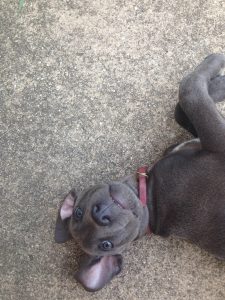
Fang, May 2016
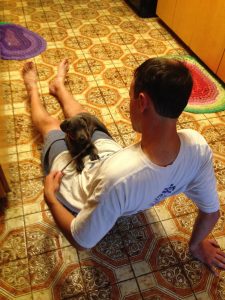
Sam and Fang
Sam (silently shaking his head): . . . .
Peggy: Oh no. Did he have a bad day?
Sam (still shaking his head): Oh, there are good things about him.
Beef stew
There is an empty bottle of soy sauce, encased in a koozy, standing on the half wall between my cubicle and that of my longtime co-worker, Bj Lewis. Bj used to eat a lot of mandarin oranges. When he calls in his hamburger order for carry-out, he always has them put Swiss cheese on it. He doesn’t like chocolate. He never eats donuts when someone brings a dozen to the newsroom. He gets really cranky when election night dinner is pizza. (And we are always grateful when it’s barbecue instead.)
So, when Bj and his family had the kind of heavy/heady stuff going on that you just have to bring them a covered dish, a salad and dessert, this is what I made.
My mom took an Asian-style cooking class at Fox Valley Tech in 1976. This stew is a little easier than boeuf bourguignon, and just as tender and flavorful.
Braised Soy Sauce Beef
2 lbs. boneless chuck roast
1 T. soy sauce
2 T. sherry
1/2 tsp. salt
1 T. cornstarch
2 T. oil
2 scallions, cut into 2-inch sections
4 thin slices of ginger root
1/2 tsp. star anise
2 T. soy sauce
1 T. sugar
1 cup water
Trim the beef and cut into 1-inch cubes. Marinate in soy sauce, sherry, salt and cornstarch for 10-15 minutes.
Heat a dutch oven until very hot, add oil, brown half the beef over moderate heat. Stir to seal on all sides. Remove from pan, repeat with remaining beef.
Return the beef to the pot, add scallions, ginger, anise, sugar, soy sauce and water. Mix and bring to a boil. Reduce heat to low and simmer, stirring occasionally, for 1 1/2 hours until meat is tender and about 3/4 cup of liquid is left. Watch the liquid level and add more water if needed.
Remove the star anise before serving over rice.
If desired, add two or three carrots that you have trimmed and cut on the diagonal in about 1-inch slices during the last 20 minutes of cooking.
Then let me be brave in the attempt
“Let me win. But if I cannot win, let me be brave in the attempt.” — The Special Olympics Athlete’s Oath
Before the Really Big Weather hit Bryan, we were there for Special Olympics last weekend.
Sam has been competing in equestrian Special O since he was 12 years old. Yet, each year his instructors find new ways to challenge him. He’s become an independent rider, first in English style. This year, he’s riding Western, too. Sam practiced competing in a few “able-bodied” shows earlier this year to help him get ready.
All that preparation is no guarantee for gold. Some riders are more experienced and consistent. Other riders have horses that are competitors, too. For example, the first clip in the video below shows Sam in barrel-racing. This is his first year to compete in this event. He is working on smoothing out his turns and keeping momentum. That got him a silver this year. But the gold medal winner rode a horse that understands The Need For Speed. I’m not sure I could watch Sam on a horse that spirited. I watch and wonder how it tolerates having a rider on its back at all.
I didn’t include the clip from trail. Sam and his horse couldn’t finish the event. There was Big Weather (just not Really Big Weather) when we were there. The horses didn’t like it. And, there were rain delays. Sam had the option to ride trail either English or Western. He chose English. But not because he felt more experienced, but because of the horse. The team saddled up Magic for English and Revenue for Western. In the week leading up to the event, he and Revenue weren’t clicking. He was concerned. Although it’s not the best video to see the difference in his two equitation events, Revenue was the more consistent performer at Special O.
On the way home, Sam remarked, “I don’t know why I was worried about Revenue. He was great this weekend.”
And then he added, “At least I kept the oath. I was brave in the attempt.”
Our prayers to the people of Bryan, the Brazos River Valley and others affected by this spring’s severe weather and flooding.
Overheard in the Wolfe House #301
(After passing another driver holding a penlight out the window on a Friday night #onlyinDenton)
Paige: Huh?
Peggy: Whatever floats your boat.
Sam: Whatever floats Boaty McBoatface.
True Blue Lacy
For the first time in 20 years, there are no dogs in my house.
Except for a very short, disastrous period with a hyper Corgi named Tippy, we didn’t have dogs when I was growing up. But I loved dogs. I studied all the different dog breeds. I read and re-read storybooks about dogs. I wanted dogs in my life.
Mark brought home our first puppy, Patch, when we moved to the farm in 1996. Part German shepherd and part chow, he grew to a gentle giant around the kids. A year or two later, a family we barely knew dumped their border collie mix at our place. We had tried once before, and failed horribly, with a rescue, so we worried about Rex. He had problems. But Mark had a good hand with dogs and slowly, but surely, Rex turned into a big, lovable lump.
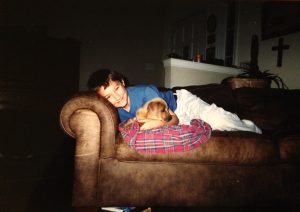
Michael and Gus, January 2002
As farm dogs, though, they weren’t particularly helpful. My dear friend, Terri, was having good luck with an old Texas breed, Blue Lacy, at her place in the Hill Country. She brought me her pick of the litter in January 2002.
He’d only been with us for a few weeks when Paige got the flu. He wouldn’t leave her side until she was up and about again.
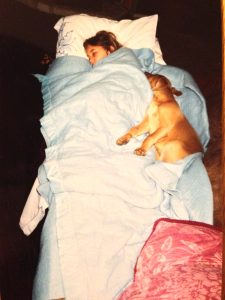
Paige and Gus, February 2002
Mark was a bit annoyed with me. Three dogs is a pack, he said, and they will be harder to manage. That’s ok, I told him, I want Gus to be my dog.
Gus entertained the kids as a puppy with his incredible energy. Once I sat my coffee down on the porch and he drank it as I looked away. The kids watched in wonder as he ran in circles, without stopping, for about three minutes, and then laid down and slept it off.
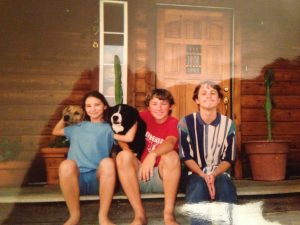
Left to right on the front porch at the farm: Gus, Paige, Rex, Michael, Sam.
Mark saw that energy could — and needed to be — directed. In very little time, Gus became Mark’s dog. I did a lot of work on the farm, but Mark did more. Gus loved to work. All you had to say was “should we go do some work?” and he ran to the door with such excitement, bounding ahead of you outside. It really was his favorite time of day. With “go ahead,” he’d scout for you as you worked the fences or a row of trees, alerting you to snakes and chasing off varmints. With “get ’em up,” he rounded up the chickens and the goats when they got loose. He tried to help when other people’s livestock got on our land.
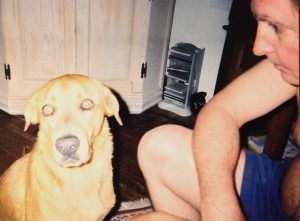
This photo is a classic shot of Mark having one of his sit-downs with a young Gus. I’m sure all that Gus heard was “blah, blah, blah” (I can’t remember what he had done wrong at this moment either), but more than anything, Gus wanted to please Mark. These little sit-downs were amazing bonding sessions.
So when Mark went to the store one night and never came home, Gus was as distraught as the rest of us. Twice he went looking for him and came home shot. Both times the veterinarian, Nub Nabors, shook his head as he looked at the x-rays. The first time Gus was shot, the bullet went clean through his chest and hit no internal organs of any kind. The second time the bullet went through the two bones of his front right leg as if threading a needle. Nub just stared at the x-ray in wonderment.
After that, Gus gave up looking for Mark.
Fast forward to life in the city, which I’ve written about before. He enjoyed these past 12 months of retirement.
Today was his last day. He got cancer and his haunches wasted away until he couldn’t hold himself up anymore. This morning, when it was time to get up and take our fake patrol in the ditch, his new favorite time of day, he gave up.
The humane thing doesn’t always feel humane.
Gus and I have been sleeping on the sofa together for nearly a year. I could sleep in my bed tonight.
But I won’t.
The little things, again
Yesterday Sam and I went to a funeral. They are always hard on us, and this one underscored both the hope and the cruelty that comes in the march of time.
When it was time to go, Sam came out of his apartment clutching a tie he’d gotten from his brother, Michael. I didn’t consider it the best match for the shirt he was wearing, but it was acceptable. He needed my help putting it on. He’s always needed my help knotting his ties.
Before I even thought about it, I blurted, “I won’t be able to do this as well as Michael.”
Michael visited a month ago, when Sam rode both English and Western in an able-bodied horse show organized by North Central Texas College. When it was time to knot his tie, Michael helped him with a beautiful, neat knot that I knew he didn’t learn at home.
He was in the middle of his junior year in high school when Mark died. He went off to college at Texas Christian University knowing a lot of things about how to take care of himself. But he never learned to knot his ties other than the simple way I faked up trying to help my boys look good. He wasn’t going to get away with that at such a prestigious school.
Michael said he watched lots of YouTube videos to learn how to knot his ties.
I wish I knew why the little things always break my heart.
8 Mile: random thoughts running the hills at Possum Kingdom
When all your favorite trails for training have been washed out, or are under water, and you haven’t run a real trail race in a year, take an 8-mile romp to get your footing back. It’s not too short. It’s not too long. It’s just right. Drive two hours to run two hours and you will be with the other runners that look like runners. (It’s not your family’s Reindeer Romp. HT @PaigeCWolfe, first-time 8-mile trail racer). Chia seeds make a first-time trail racer hyper. When it rains in Texas, Texas turns green and purple and green and yellow and green and white, and green. A mockingbird perched on the safety light by the port-a-potties will sing all he knows, the chirps, the tweets and warbles, the chirrups and gurgles, the cardinal song, and the car alarm. What do you name your back country road when you can’t think of a name for your back country road? “Our Road.”
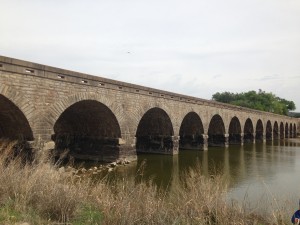
WPA bridge over the Brazos River, Graford, Texas, April 12, 2014
Sam rides barrels for the first time
Sam says “well, that was fun.”
Riding Western
Sam competed for the first time in Western style horseback riding at the North Central Texas College stock show last weekend in Gainesville. He competes with “able-bodied” riders from time to time to challenge himself. This was great practice for next weekend. The regional equestrian Special Olympics are being hosted by the stables where he rides, Born 2 Be, in Aubrey.
His coaches have been encouraging Sam to ride Western for a while. Sometimes it takes Sam a little bit to warm up to an idea. He put jeans on for the first time in about 20 years when he tried on a new pair of Wranglers at Weldon’s Saddle Shop last week. (Like his great-grandfather, whom he was named for, Sam’s a khakis man.) Kippie helped him look good, although it’s a mystery where those most excellent chaps came from. Sam says they were, like lots of gear, donated to the stables.
Enjoy.