

self-advocacy
The Grand Tour
I missed the big day when the WinCo warehouse had its open house almost two years ago. Michael and Paige went with Sam, and got to see where Sam had trained as well as the spot where he works inside that massive building.
Sam will celebrate his second anniversary with the company in March. A few days ago, I took part of the day off to ride to work with him and finally get a tour of the place.
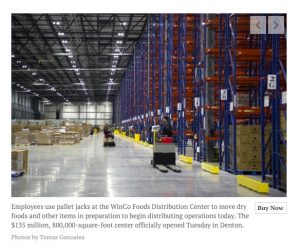
(Here’s a news story from the opening, shown in the Denton Record-Chronicle photo shown above.)
Sam’s unit unpacks small dry goods, such as shampoo and lotion, that are continuously delivered to the warehouse. They move them into bins that can be quickly accessed for shipment to stores in the region. (Sometimes he works on that repacking side, too.) They keep about 18,000 inventory bins stocked at all times. Much of the work is automated, which means he’s working with computers and all kinds of lifts and conveyors.
Once they’ve unpacked a delivery box, they throw the empty box up on a conveyor to the cardboard compactor, which was the highlight of the tour for my inner 8-year-old. The grown-up in me nearly melted watching his face light up showing me how it all worked. He is clearly enjoys his job, and is good at it — his supervisors told me as much, too.
When Sam first joined the workforce almost 15 years ago, a dear friend in the rehab department at the University of North Texas told me that Sam would learn and grow a lot on his first job. I was so grateful that he told me that, because I knew not to be surprised, and to be alert and responsive to those changes. I remember how challenged I felt entering the work force (a feeling that returns with each new job, and sometimes each new assignment, honestly), but I wouldn’t necessarily have connected to those experiences and been ready to help Sam in reinforcing his growth and understanding all of his new experiences, rather than being bewildered by them.
For example, I told him he might be surprised at how tired he would feel going from part-time to full-time work, especially such physically demanding full-time work. He was happy I shared that experience. After a few months, he was ready to advocate for himself in a powerful way: to get moved to swing shift. He knew he was not a morning person and that he needed more rest than he was able to get working day shift.
He also gained a lot more confidence in his strength. I don’t know what it is about autism, but it seems like lots of kids with autism don’t grow up with the core strength that most neuro-typical kids have. Horseback riding probably helped Sam get stronger than he was initially wired for.
But I knew WinCo put that over the top when I asked him to help me load a dryer on the back of my pickup, the kind of two-person job we had done many times over the years. I planned on taking the dryer to my girlfriend in Houston, who’d been all but wiped out by Hurricane Harvey’s flood waters. After I put down the tailgate and anchored the ramps, I turned around to see that Sam had already loaded the dryer on the dolly. He walked it all up the ramp without a word, like the grown-ass man he is.
Internet commerce is a wild web
If Sam wrote up his tips for how to avoid getting scammed, it would read something like this.
- Don’t read email
- Don’t respond to texts
- Don’t answer the phone
- Open snail mail only after your mom nags you for a week that it’s important
And still things happen to him. I try not to hover. He’s a grown-ass man. He managed to handle something this week that would make Dave Lieber and his Watchdog Nation proud: he got a refund from a seller on eBay.
Sam is working on backing up his computers cloudlessly. It means he needs some external hard drives, and some redundancy. It’s a good project for him. One of the devices he bought for the project wasn’t the right device. He sent it back to the seller. He got proof that he sent it back and the seller received it. But the seller was very slow in refunding his money. It was a lot of money–$120 or so. He complained to eBay and then he went over to his bank to see what they could do. This is where I give a big shout-out for the power of local banks who get to know their customers, because they helped turn up the heat with PayPal. Sam announced this morning that eBay is refunding his money.
Sam said, “I was starting to think that the seller wanted to sell me the wrong item and keep my money.”
That’s an excellent demonstration of being able to take the perspective of another and act accordingly, something that is hard for people with autism to do.
I told him that eBay and other e-commerce platforms need sellers to be honest or their platform becomes irrelevant. I used to not tell Sam things like that. But, he’s getting the hang of this seeing-situations-from-another-person’s-perspective thing.
He still wants a better consumer tip sheet, and he’s got a point. When he was at the bank, he learned about “verified sellers.” In the 23 years eBay’s been around, I think I’ve bought two things on that platform. I really have no idea. I’ve got my homework for the week.
And, if anyone has good consumer tips about eBay, please leave them in the comments below.
No going back
Sam lost his sunglasses in Germany.
There wasn’t anything remarkable about the sunglasses themselves. They were a pair of sunglasses that had been lying around the house for years, a little scratched, but durable both in their purpose and their terrific ability to avoid getting lost the way most sunglasses do.
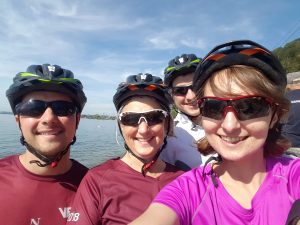
Sam, myself, Michael and Paige on the Lake Constance bike trail from Bregenz, Austria, to Lindau, Germany.
The loss, though, became a valuable lesson for our family.
I knew the trip would challenge us, biking more than 150 kilometers over the course of five days. At the end of the first day’s two-hour ride, Sam turned to us and said he was confident that he had trained enough for the trip.
He had been a little nervous about it, but we set out on hourlong rides several times a week in the months before. Inspired by Michael, he also hooked his bike up to a wind trainer for regular spins.
The third day, our second full day of riding, set out as our longest ride of the week. We left our hotel in Lindau to cycle to our next hotel in Uberlingen. Most of the people in the riding group took the shortcut, taking the ferry from Friedrichshafen to Meersburg to finish the ride. We met the group and told the tour leaders that we wanted to cycle through the orchards and vineyards rather than ride the ferry.
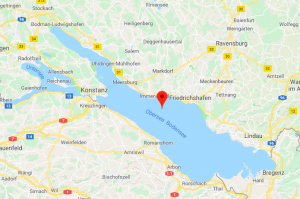
Lake Constance
About halfway to Meersburg, we stopped to refill our water bottles and have a snack. Sam asked where his sunglasses were. He thought someone had grabbed them for him in Friedrichshafen, where we all took a bathroom break.
No one had. Sam asked if we could go back and get them. Michael told him, “Sam, there’s no going back. We’re already pretty far from Friedrichshafen, and we’re riding 40 kilometers today.”
Sam protested briefly, but got back on his bike and plowed ahead. When we arrived at Meersburg for lunch, he was still upset. We sat at a table beside the lake and Sam tried to explain. It wasn’t going well and people were starting to stare. I invited Sam to take a walk with me to the water’s edge so he could collect his thoughts and I could make more room for listening.
There was another family walking on the little beach with their German shepherd. They threw sticks into the waves. The dog wouldn’t venture past depths over its head, but it worked hard to bring back every throw.
Eventually, Sam was able to collect his thoughts.
He understood that sometimes we help him out as a trade-off, to get things moving faster, especially when being slow is risky. But when he is responsible for himself, “I need more time,” he said. And he said that it was clear to him on this type of excursion, a person has to be responsible for themselves.
Most of us human beings don’t have enough self-awareness to assess these kinds of scenarios, let alone ask simply and directly for the fix. Sam constantly amazes me with this gift of his.
We went back to the table and announced the findings. We all agreed we could and should slow down our transitions. Paige asked Sam about a checklist. What if each of us went through a checklist, like an airline pilot, before we cycled on? The process helped us slow down for Sam and, at one point, also kept me from losing my cycling gloves. We often were the last ones of the cycling group to leave, but because we rode fast, it all worked out in the end.
I told Paige later that day that I did have a secret hope that the trip would stretch the family, although I wasn’t quite sure how. I hoped we wouldn’t be miserable, but I didn’t worry about it either.
Learned helplessness does someone like Sam no service at all, and some of that was coming from our habits to take shortcuts and speed things up. He deserved more from us. We learned we could step back, let some conflict points rise up and not freak out. After all, Sam is a grown-ass man.
Overheard on the Wolfe House #310
Peggy (seeing the clock read 9 a.m.): Well, good morning! How’s the change to afternoon shift?
Sam: Good. I’m getting all my sleep back.
Be the Bumper Guard
After my family moved from the Midwest to Colorado, we started a new Christmas tradition. My grandmother, who lived in Rockford, would send a little cash instead of gifts for Christmas. She forbid my parents to use the money to pay bills. It was to have fun, she said.
So, Christmas Day, we’d all go bowling. As we grandkids had kids of our own, we kept on bowling for Christmas. Some years we’d take up as many lanes as a league would.
Those first few years, it was hard to watch the little ones learn to bowl. They would hit pins, but they would also throw a lot of gutter balls. The year the bowling alley offered lanes with bumper guards was its own kind of Christmas. The bumpers didn’t eliminate the gutter balls, but the set-up helped the kids figure out what they were supposed to do. It was nice to sit back and let them have at it. They were set up for success: they got a lot more pins and they learned more quickly how to throw. By the second or third year, my nephew was ready to ditch the bumpers and bowl in a lane with the grown-ups. He bowled great games.
My kids are grown and I’ve stopped parenting, but when Sam needs support now, I try to remember to be a bumper guard, just like I did when the kids were little.
We parents need to stand on the periphery of their lives, far enough back that the kids know they are doing things on their own, but that you’re watching, too. They need that internal message that they shouldn’t worry about hitting a lot of pins, and that they are still going to throw gutters, and sometimes the ball is going to ricochet its way down the lane, but just keep throwing and try to get strong so you can throw it straighter each time. And one day you’ll be ready to go without the bumpers. You will hit some spares and strikes and you’ll throw some gutters. And it will all be ok.
I don’t always remember to be a bumper guard. A few weeks ago, I thought someone had drained Sam’s bank account. Fear turned me into a helicopter parent. Of course, my actions, ostensibly to defend his hard-earned money, upset him. And they created other problems that he needed to solve. When I remembered my role and stepped back, he cleaned up the whole mess himself.
Our culture is changing rapidly. To survive and to thrive, all of our children, not just the ones with autism, need to be resilient. We should not stand over them and help them throw all the balls. That’s not how to make a resilient kid. With each situation, each problem, each opportunity for growth, we need figure out where to install the bumper guards, stand back and let them throw.
Butterflies
Sam was spared the agony a lot of us get in the home stretch for a new job: the long wait between a successful interview and the offer. On Friday, one rolled right after the other for him. He had the best smile when he announced over dinner that WinCo hired him to work in the warehouse.
Sam sacked groceries at Albertsons for ten years. He didn’t want to become a checker. Sometimes customers are impatient. “I wouldn’t be fast enough for them,” he said. He didn’t want to stock shelves, either. I shopped late enough on the occasional Friday night to see those guys at work. Sam couldn’t be that raucous.
Nothing came his way after he graduated with an associate’s degree and certificate in computer science and technology five years ago. It was frustrating. Once I asked a manager at Albertsons if there was a way for a loyal employee with an education to move up. She shook her head no. There aren’t corporate offices here, she said.
Then Sam got a call. WinCo was opening a warehouse in Denton. They wanted to try to hire people like Sam. He would have to quit his job at Albertsons; participate in a special, six-week training class; and interview for the job at the end. There was no guarantee he’d have the job when he finished the training. In addition, he would only be paid when he was handling actual store product in the warehouse. Otherwise the rest of the training time would be unpaid. This was a Goodwill Industries program. The training included a lot of class time on “soft skills,” like getting along with co-workers, deciding when (and when not) to disclose your disability, interviewing techniques, and the like.
Sam had been in the work force for a decade. He’d been there and done that. It didn’t seem fair for him to quit a job and go without pay for four weeks. But I know I can be skeptical. It’s an occupational hazard. I kept my mouth shut. He had a chance at a job that would quadruple his take-home pay.
(Some nights he’d come home, relay what they learned that day and I’d muse over how it might be nice for the newsroom to get a “soft skills” refresher from time to time. We often seem barely house-trained–myself included.)

Image from Nova: Journey of the Butterflies
This week was all butterflies. I missed the open house Sunday, but Michael and Paige went with him to see for themselves what he was shooting for. We were prepared to help Sam update his resume. No need, he said, the program folks already got his resume all wrapped up. Did he want to do some mock interviewing? Nope, he said, he’d already practiced and had notecards with sample questions and answers. He’d just look them over each night, thanks.
He was visibly nervous Thursday night. A lot had lead up to that day. He made sure he had all his interview clothes ready to go and packed up work clothes, too. After the interview, he expected to be back out on the floor, in his bay, and he needed to wear a sturdy shirt, jeans and his work boots. I kept checking my phone all day for news, but that’s not his style. He was epically impulsive as a child, but now, he almost delights in waiting to deliver good news.
I don’t know who was smiling bigger on Friday night when he told me. If it were Michael or Paige, there would be lots of hugs and backslapping and arm-squeezing. But that, too, isn’t Sam’s style. I told him I’d like to shake his hand to tell him congratulations and how proud I was of him.
He kept eye contact as he extended his hand and gripped mine. Not too hard, not too soft. Up and down, not too fast and not too slow.
I kid you not, dear Internet people.
It was the first time in my life I’ve ever experienced the perfect handshake.
Smart thermostats anywhere
By Sam Wolfe, Guest Blogger
According to the recently published news story, “Smart thermostats remember for you,” a thermostat that is “just about as smart but doesn’t connect to the Internet” was installed in the back side of this home. (We live in northwestern Denton.)
Only one wire was available to power the thermostat. According to HVAC technician Bill Clark, the thermostat pictured in this story needs two wires to operate, a hot wire and a common wire, as do all other smart thermostats you can buy.
Research shows that the common wire is not available in some applications with a non-heat pump system. This requires battery power to a digital thermostat. Only a conventional thermostat or a programmable thermostat (one that is “just about as smart but doesn’t connect to the Internet”) could be used in these applications … until now.
With a Venstar Add-a-Wire accessory box and diode, you can simply “turn one wire into two.” For more information about this accessory, follow this link:

thermostat in back of house
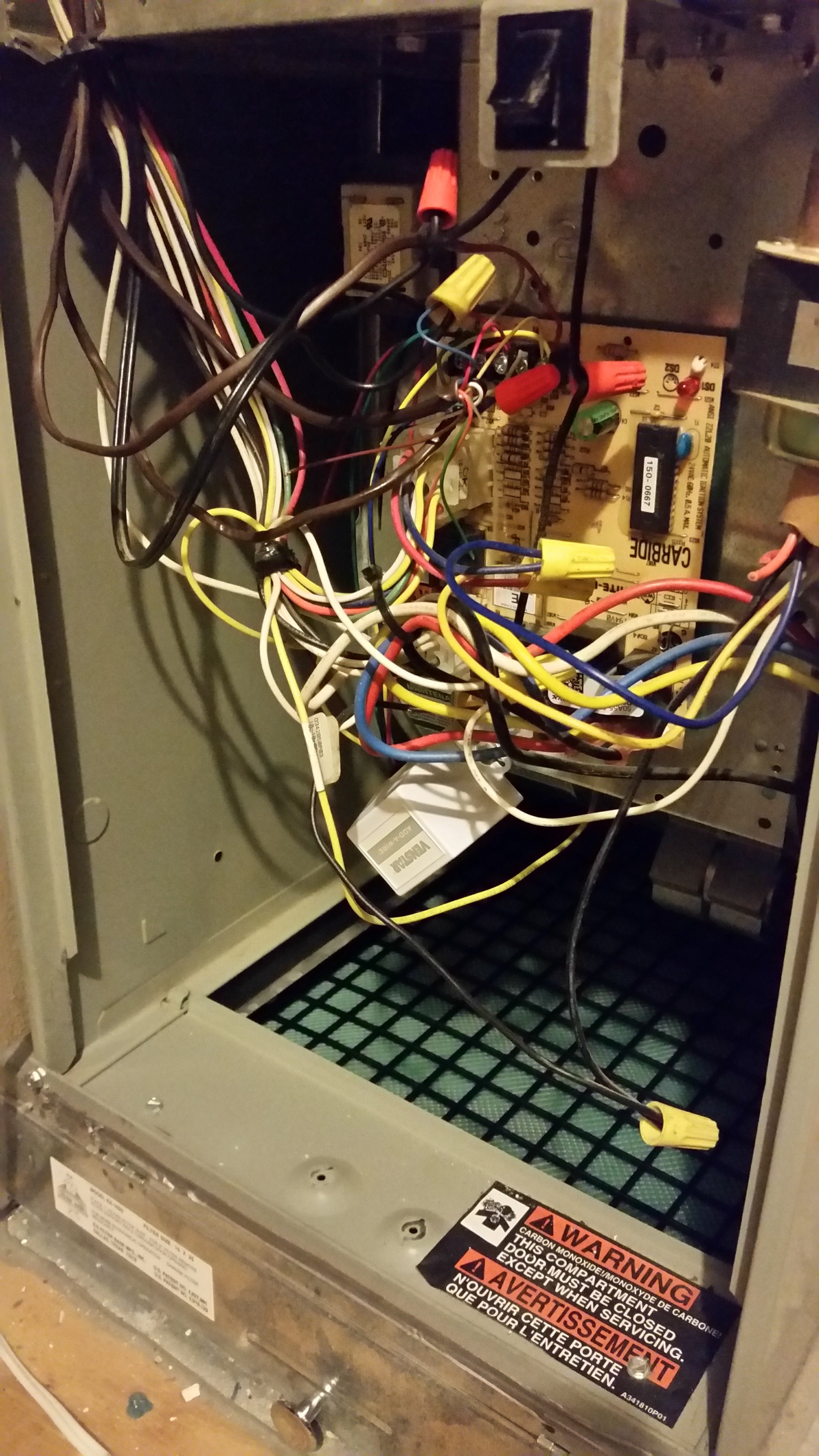
accessory box installed in furnace
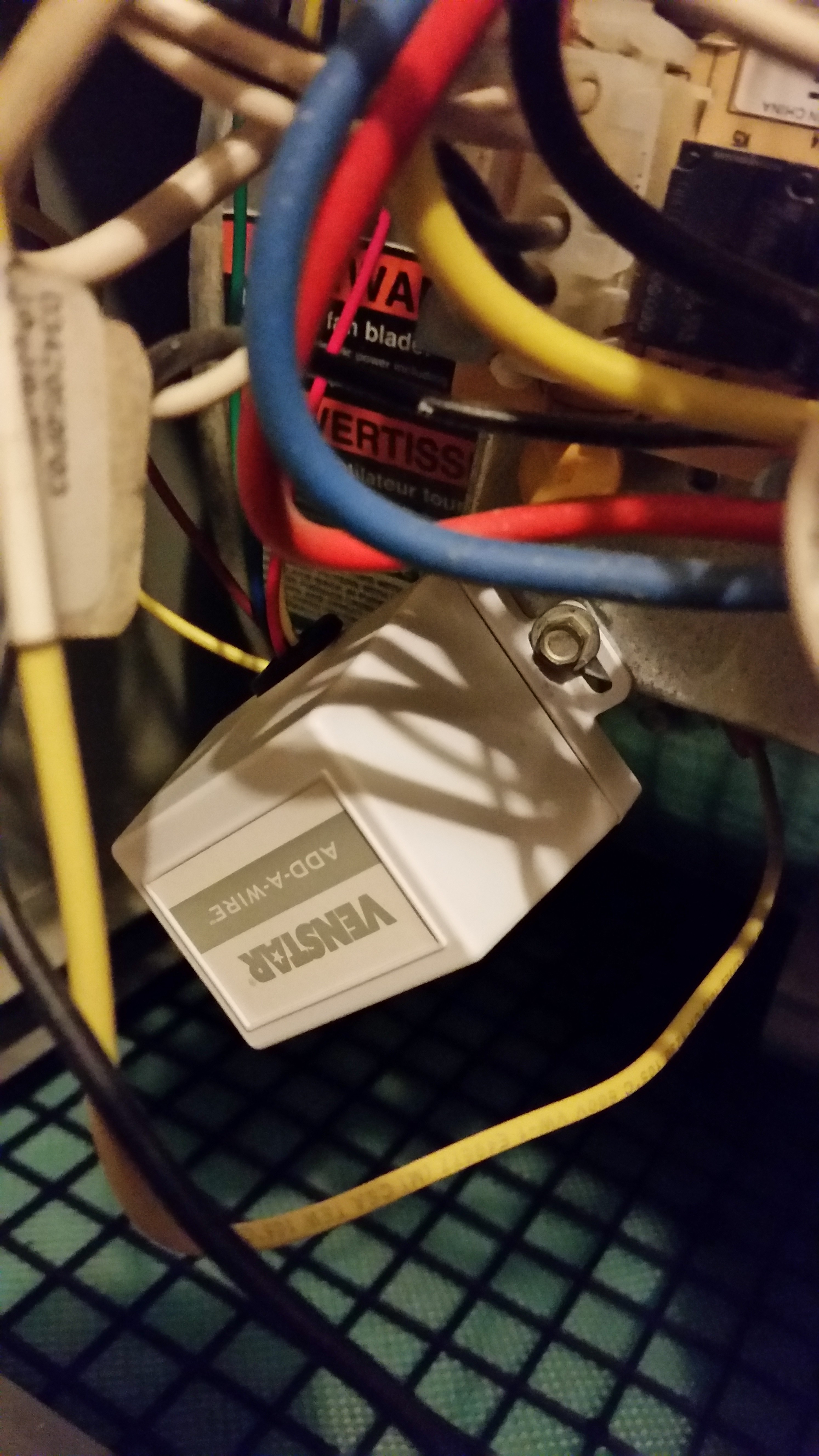
close-up view of accessory box
Note from Peggy: Sam was terribly disappointed after we were able to install an internet-ready thermostat in my house, but not his apartment. (For want of that wire. I wasn’t going to pay to lay more wire in the attic.) He went in search of a solution to that problem and found the add-a-wire device. After I asked him to make sure it was UL-listed, he ordered it, and then installed both the add-a-wire and the internet-ready thermostat in his apartment (which is in the back of the house) himself. He took the photos of his handiwork so you can see what he did.
Overheard in the Wolfe House #297
Sam (after playing “good cop”): Mom, you were really pushy this morning.
Peggy (after playing “bad cop”): Yes, I was.
Sam (face in hands): I’m not sure it was the right thing.
Overheard in the Wolfe House #296
Peggy: How was work? Long day?
Sam: I’m taking a nap. If I had a ‘do not disturb’ sign, I would hang it on my door right now.
Outward Bound, the indoor edition
“Because you know, nothing bad ever happens to a writer; everything is material.” – Garrison Keillor quoting Philip Roth.
I learned about stage fright at age 10. I had been taking piano lessons for a year. My memories of that first spring recital are a little foggy, except, just before I sat down to play, I saw my dad slip in the door of the recital hall (someone wheeled a spinet piano into the school cafeteria). And I played my song without stopping.
That’s a victory when you are 10 years old.
After the recital was over, I went home with my dad. I tried to eat dinner, but instead I vomited and went to bed.
I loved playing the piano, though, so I kept up with my lessons. I didn’t play again in public for about five years. When it was time, my new piano teacher was clever. (I didn’t tell Mr. Kaehr about my stage fright. But he apparently knew and he knew how to prepare me.) He had me work up Ernesto Lecuona’s Malaguena – so fun and flashy – to play during the honor society banquet. When I was done, the crowd’s reaction told me that they didn’t expect what they’d just heard. That was incredibly affirming, enough for me to perform, and recover from performing, vomit-free, for several years.
When I headed to college, I majored in music. I could get through the performance of a single solo on a departmental recital all right, but putting together an entire solo recital was another matter. I could channel that adrenaline for 10 minutes, but not an hour or more. After one recital I couldn’t even make it through the reception afterward. Went home, vomited and slept all weekend.
I’ve never thought of myself as a risk-taker, especially compared to my late husband. To Mark’s credit, however, he thought through things. In his mind, he wasn’t taking risks. He was fearless in persevering and adapting. I tried not to be afraid of opportunities, or leaning in when problems showed up.
For example, we recognized we couldn’t get help for Sam if we were shrinking violets. We spoke up, we stood fast, we made plain that we expected delivery of the help he needed. Neither of us would take credit for what Sam has accomplished. However, we would have admitted to sweet-talking, cajoling, persuading, wheedling, and outright pushing the people around him when and where necessary. (And, I’m sure, where others in his life might have said wasn’t necessary.) I learned to channel that swirling adrenaline for the length of special education team meetings.
After Mark died, there was no hedging. All bets were off.
Still, I didn’t recognize being in small claims court this week as an indoor edition of Outward Bound until it was over.

A friend, who’s a lawyer, told me that what I’d just done many lawyers in town have not done: argue my case in front of a jury.
When the jury was out, I did confess to the bailiff that the experience was terrifying.
Sad to say, in the Texas justice system, there apparently is nothing in between refusing an insurance company’s first offer to settle your case and finding yourself in front of a jury — unless you just want to up and say ‘never mind.’
Last year, this happened: 
My insurance company investigated and determined I wasn’t liable. But the truck is so old, I only carry liability. I was on my own with the other guy’s insurance. And, as Mark would say, “just to make this really interesting,” this company has a poor reputation with many people.
Including me. I’d gone to the mattresses once before with this company.
I refused their first offer, which was totally inadequate. They never budged. When I sued in small claims, I expected mediation or arbitration. I hoped for another offer.
Nope. Nothing. Nada.
Their response to my petition was to ask for a jury trial. I think I was supposed to run from the room at some point, but that just never occurred to me.
I was sticking up for myself and my family.
I lost the argument before I could ever start. The insurance company’s attorney called for a pre-trial conference with the judge to make sure I couldn’t tell the jury much of anything at all.
I felt bad for those people. What a waste of their time. They had no idea.
The whole ordeal lasted two hours. It was a terrific education into the Texas justice system that I won’t soon forget.
And, when I finally got home that day, I didn’t vomit.