

Macaroni and cheese. At last.
When the kids were little, we did our best to feed them wholesome foods made from scratch. But we weren’t rigid about it either. We made one tough rule when we recognized what a Happy Meal could do to your kid’s metabolism.
I used to juggle time at work to be able to take Michael, when he was about 10 years old, to tae kwon do after school. He would beg me on the way home for a snack. There was a 20 minute drive ahead. The McDonald’s drive-thru was two blocks away, so we’d pick up a Happy Meal. Since it didn’t spoil his appetite, I didn’t think there was any harm. However, after about two months of that routine — with two-three Happy Meals a week — I saw a little paunch growing around his belly. I figured out a way to bring Michael a healthy, filling snack for after tae kwon do. And I told Mark I was concerned how fast that change came on.
We decided that the kids could no longer have fast food. To make it up to them, we would make hamburgers and fries once a week.
It was a production, but that’s also when we always had venison in the freezer. We had a bread machine, so that gave me a leg up to make hamburger buns every weekend. On hamburger-and-fries day, we’d cut about 3 pounds of potatoes into sticks and soak them in cold water so they would come out extra crispy. Mark would fire up the grill for the burgers and the turkey frier for the fries, no matter how cold it was outside. I’d run a large paper grocery bag in the microwave for a minute to sterilize it … that’s how we drained all those fries.
It was a great meal and the kids didn’t seem to miss out on fast food.
That routine gave me hope that we could quit mac-and-cheese from a box. I worked hard one Saturday to prepare it from scratch. Oh, how they complained. It didn’t taste right. It was the wrong color. It felt funny in your mouth. I was sorry I made so much, but, of course, the dogs weren’t.
For Thanksgiving this year, I decided to make macaroni and cheese. It had been more than 10 years since my last attempt. I was nervous. I knew Sam wouldn’t like it. He hated mac-and-cheese when it came out of a box. He says cheddar cheese is too “dactyl.”
(Paige and I think he’s invented his own word that mixes meter — a la waltz, long-short-short — with “tactile,” which does not bode well for cheddar cheese’s reputation.)
I knew Aunt Regina would like the mac-and-cheese I made. I knew I would like it. I knew Gus would like it.
I was bold. I made 8 servings. Michael took one bite and said “well, this won’t last the day.”
I had big plans to make leftover hot turkey sandwiches, panini-style, with green apple, bacon and bits of that mac-and-cheese. That didn’t happen. Yes, internet people, this is the one.
Mac and Cheese
1 pound macaroni
2 cups bread crumbs
6 tablespoons of butter, divided
3 tablespoons of flour
1 cup cream
2 1/4 cups milk
1 1/2 tsp. dry mustard
salt, pepper
8 ounces extra-sharp cheddar grated
4 ounces parmesan, grated
4 ounces Swiss cheese, grated
Preheat oven to 350 degrees. Grease a 9×12 casserole dish. Bring a large pot of salted water to boil and cook the macaroni al dente. Drain and return to pot to help it stay warm. Melt 3 T. of the butter and pour over the bread crumbs in a bowl. Grab a handful of the Parmesean and mix together with the breadcrumbs. Set aside. Melt the other 3 T. of butter in a sauce pan, stir in the flour and make a brown roux. Meanwhile, have the milk and cream heating in another pan (but don’t let it get hot enough to get a skin on it.) Slowly add the milk, cream and mustard to the roux and cook until nicely thickened. Stir in all the cheeses, salt and pepper to taste. Pour the cheese sauce over the noodles and gently fold to incorporate. Pour into the casserole and dust the breadcrumbs over the top. Cook for 20-25 minutes until bubbling throughout and brown on top.
Smart thermostats anywhere
By Sam Wolfe, Guest Blogger
According to the recently published news story, “Smart thermostats remember for you,” a thermostat that is “just about as smart but doesn’t connect to the Internet” was installed in the back side of this home. (We live in northwestern Denton.)
Only one wire was available to power the thermostat. According to HVAC technician Bill Clark, the thermostat pictured in this story needs two wires to operate, a hot wire and a common wire, as do all other smart thermostats you can buy.
Research shows that the common wire is not available in some applications with a non-heat pump system. This requires battery power to a digital thermostat. Only a conventional thermostat or a programmable thermostat (one that is “just about as smart but doesn’t connect to the Internet”) could be used in these applications … until now.
With a Venstar Add-a-Wire accessory box and diode, you can simply “turn one wire into two.” For more information about this accessory, follow this link:

thermostat in back of house
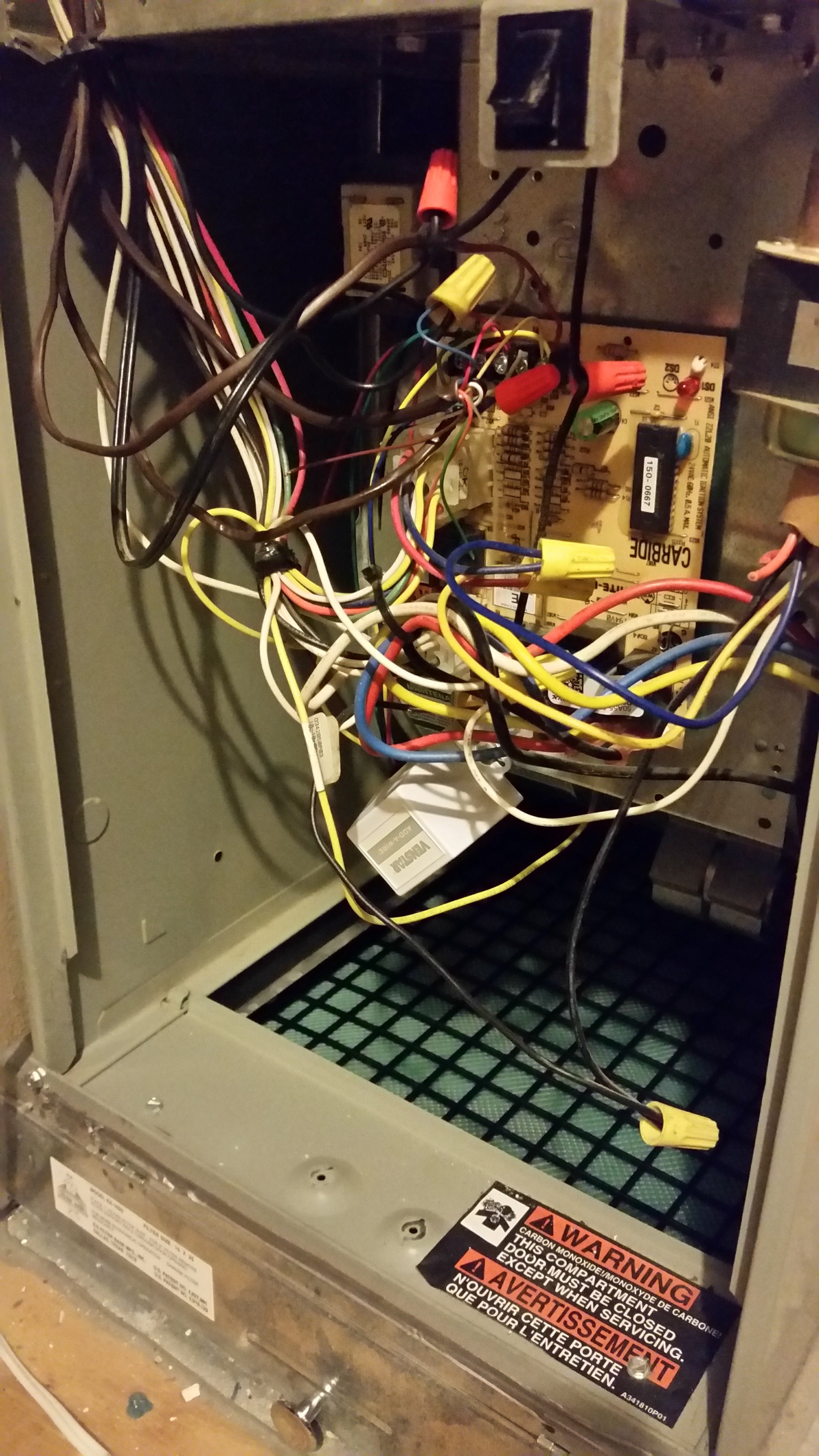
accessory box installed in furnace
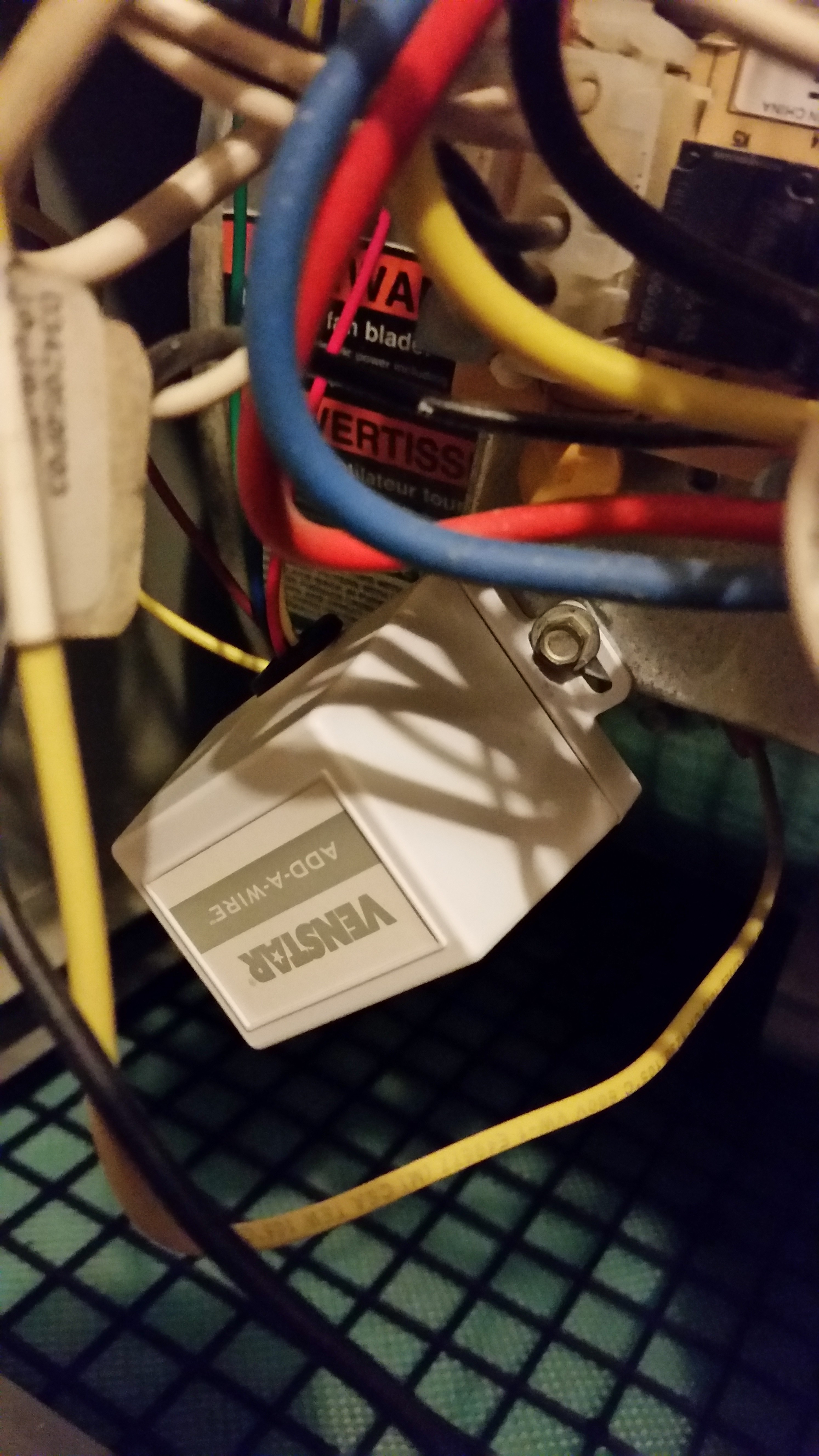
close-up view of accessory box
Note from Peggy: Sam was terribly disappointed after we were able to install an internet-ready thermostat in my house, but not his apartment. (For want of that wire. I wasn’t going to pay to lay more wire in the attic.) He went in search of a solution to that problem and found the add-a-wire device. After I asked him to make sure it was UL-listed, he ordered it, and then installed both the add-a-wire and the internet-ready thermostat in his apartment (which is in the back of the house) himself. He took the photos of his handiwork so you can see what he did.
Overheard in the Wolfe House #300
Sam (following Peggy into the house at midnight): Hey, Mom . . . (pauses, studies her face) Tuesdays are really bad for you, aren’t they?
Peggy: Yes.
What survives
Even before airlines got in the business of charging for your luggage, I packed as little as possible. I spent a week in the Florida Keys with my sisters living out of a small suitcase. My inappropriate dress for an impromptu dinner at a swanky tapas restaurant in Key West notwithstanding (hey, it was ok for Sloppy Joe’s bar, plus it was pouring rain most of the day), I believe I still packed too much.
The last time Mark and I spent a week in Hawaii, we took one large suitcase between us. The only time I flew with more than I could carry was on the way home from Japan. I spent the fall of 1986 there as a music student and visiting artist. I flew over with one euphonium and came home with two. I brought back reams of sheet music, both original compositions and inventive arrangements. I managed to keep everything confined to a trunk and carry-ons. When I got off the plane, I rented a cart and yet could barely balance all the luggage as I wheeled through Honolulu International Airport.
Over the years, little of what I brought back remains. I’d always suffered from TMJ, but it became untenable 15 years ago and my horns went in the case for good. After Mark died, I sold them and donated all our music, including what I brought back from Japan, to our alma mater.
I hung on to a few small things over the years that I treasure from that time, including a set of eight Japanese prints that I was finally able to get framed earlier this year.

During my time as a student at Kunitachi College of Music, I took a history of Japanese music class taught by a brilliant historian who, unfortunately for me, didn’t speak much English. (My Japanese was terrible.) Another student attended class with me to translate. Hiromi did her best to explain. The professor was kind and gracious. At the end of the fall term, he invited Hiromi and me to his home for lunch and tea. He wanted us to see his traditional garden and his collection of wood block prints, which Hiromi told me was famous. He seemed to have tended to every branch and blade of grass in his tiny garden. He filled one room of his home from floor to ceiling with boxes of traditional wood block prints. It was like being in the back room of a great museum with the collection’s curator. He wanted me to have one set as a gift. I was stunned. When I picked a brightly colored set that wasn’t very valuable, he told Hiromi to tell me that I really could have any one I wanted, even a valuable set. I demurred. I think Hiromi helped us both save face by reminding him that Americans have odd taste.
He put the set in a little manila envelope. That envelope managed to move from Japan to Colorado, and then to California, and finally to Texas intact. I was lucky. In 1996, Mark and I met a lovely couple through church. When Mark learned that Marcy was a conservator, he showed her the Wolfe family Bible and asked for her advice on how to best keep it and some of the items that had been tucked between its pages, including a braided lock of blond hair.
Somehow my little collection of prints fell out in that show-and-tell. Marcy saw them and said they needed to get out of the manila envelope. She helped me put them in acrylic sleeves. They sat in the conservation box with the family Bible for another 20 years.
After I sold the farm, it was time to get them framed. Museum glass and everything. I had so little left from Japan, I wanted to enjoy these prints.
When I dropped into Art Alley and pulled the prints out of the acrylic sleeves, I watched owner Randy Axtell’s eyes pop as he took a step back. “Oh wow. These are the real deal,” he said. He measured and measured again. We made a careful plan for framing.
Randy urged me to write the story of how I came to own the prints and put it on the back of the frame for posterity.
This is the start of that story.
I still don’t know a thing about them. I would imagine some expert would tell me they are all hung in the wrong order or something.
That’s not what’s important to me. I love the bright colors and the scenes they depict.
These eight pieces of paper have endured.
That’s a story right there.
Overheard in the Wolfe House #299
Sam: Michael has “house rules” for visiting him.
Peggy: Yes. Many people have house rules for guests. Grandma and Grandpa have house rules.
Paige (remembering her University of Iowa roommates): We had house rules, too, Sam. You had to tell us in advance if you were going to come over. And you couldn’t eat our food.
Sam (after a pause): I have house rules. No temper tantrums. And don’t make a mess.
Overheard in the Wolfe House #298
Peggy: Rules for writing a resume aren’t black and white.
Sam: So, not like 1960s television.
Overheard in the Wolfe House #297
Sam (after playing “good cop”): Mom, you were really pushy this morning.
Peggy (after playing “bad cop”): Yes, I was.
Sam (face in hands): I’m not sure it was the right thing.
Sangria and The Loser (with homemade falernum)
Here are some cocktail recipes my co-workers helped me taste test, here at the house, on a recent Saturday night, playing Cards Against Humanity.
We’re good people. Really we are.
I didn’t set out for the party to have a cocktails-with-a-literary-twist Tequila Mockingbird theme, but it did. I think that’s because we writers enjoy a good drink.
We’ve done this before, except mixing up old-fashioneds because that’s what Don Draper did.
We tried out recipes I found in the newspaper. I clipped a page from the Denton Record-Chronicle years ago and kept it because it had recipes for saffron cocktail onions and preserved cherries and tiki drinks that needed falernum.
It’s hard to find falernum. Charles Dickens described it in his literary magazine, All the Year Round, as “a curious liqueur composed from rum and lime-juice.”
I made some and we used it to mix up Losers, which was barkeep Todd Thrasher’s take on the rum swizzle.
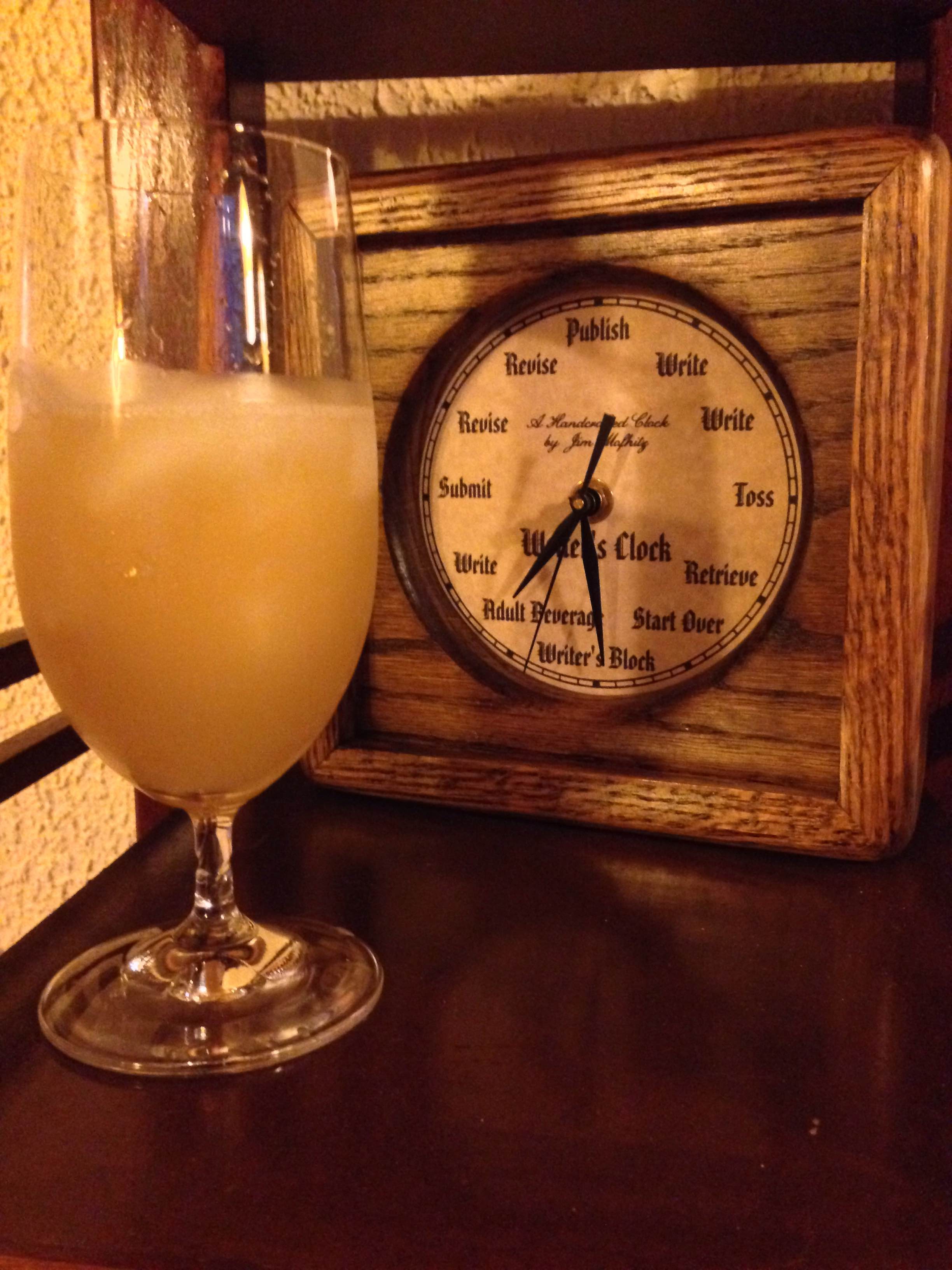
A glass of The Loser being served during the Adult Beverage Hour of the Writer’s Clock.
And we downed a pitcher of some of the best sangria I’ve ever had, my-and-my-daughter’s take on a recipe in The Guardian.
Falernum
10 limes (organic, you’re going to use the peel)
10 whole cloves
5 whole unsalted almonds
1 tsp. sugar
1 liter white rum
Peel the limes, taking care to cut away any of the white pith. Combine the peels with the cloves, almond, sugar and rum in a large glass container. Store, loosely covered, in a sunny place for three days, strain and discard the solids. Pour the liquid into a jar or bottle and cover. Store at room temperature.
(You can juice the limes and save it for another use … such as mixing up Losers.)
The Loser
1/2 ounce falernum
1 ounce dark rum
1/2 ounce fresh lime juice
3 ounces pineapple juice
Ice, pineapple slice (optional)
Fill a highball glass with ice. Add falernum, rum and juices. Pour into cocktail shaker and back into the glass (because, like Bond’s martinis, this cocktail is better shaken, not stirred). Garnish with a slice of pineapple, if desired.
Sangria
1 orange (organic)
1 bottle red wine
1 bottle pink m0scato
1/4 cup brandy
1/4 cup madeira
1 cup sugar
1 cup water
About 1/2 cup orange juice
Slice the orange thinly and muddle in the bottom of a large ceramic pitcher. Open the wines and pour in the pitcher with the brandy and madeira. Chill for a day. About an hour before serving, combine sugar and water in a small saucepan and heat until the sugar is dissolved. Let cool slightly and then pour into a large pyrex glass measuring cup (at least two-cup size). Add enough orange juice to reach 2 cups and then combine with wines in the pitcher. Add several cups of ice before serving.
More fun with Arduino
I asked Sam if these little Arduino computer-building projects he does once a month at North Branch Library was just building, or coding, too.
He says he has to edit code to get the devices to do what he wants them to do.
Here are two more short videos of the results of the build. A timepiece and a pinwheel (but you tell me if it doesn’t make you think of a jumping bean.)
What we do for air conditioning
I doubt my late husband could have convinced me to move from California back to Texas without the miracle of air conditioning. I still marvel at how I lasted the first months of my freshman year at North Texas State University, moving from central Wisconsin into an un-air conditioned room on the fourth floor of Bruce Hall.
(There were showers full-on cold every morning and night, swimming in the pool that used to be across from Willis Library, and everything iced. And more showers. Go, Mean Green.)
I try not to think about those beautiful California delta breezes at 4 o’clock in the afternoon in August in Texas. In Sacramento, the winds shifted just as the summer afternoon got hot. Those delta breezes pulled in air cooled by the Pacific Ocean.
Summer outstays its welcome here in Texas, the way winter does in Wisconsin. Air conditioning makes it bearable.
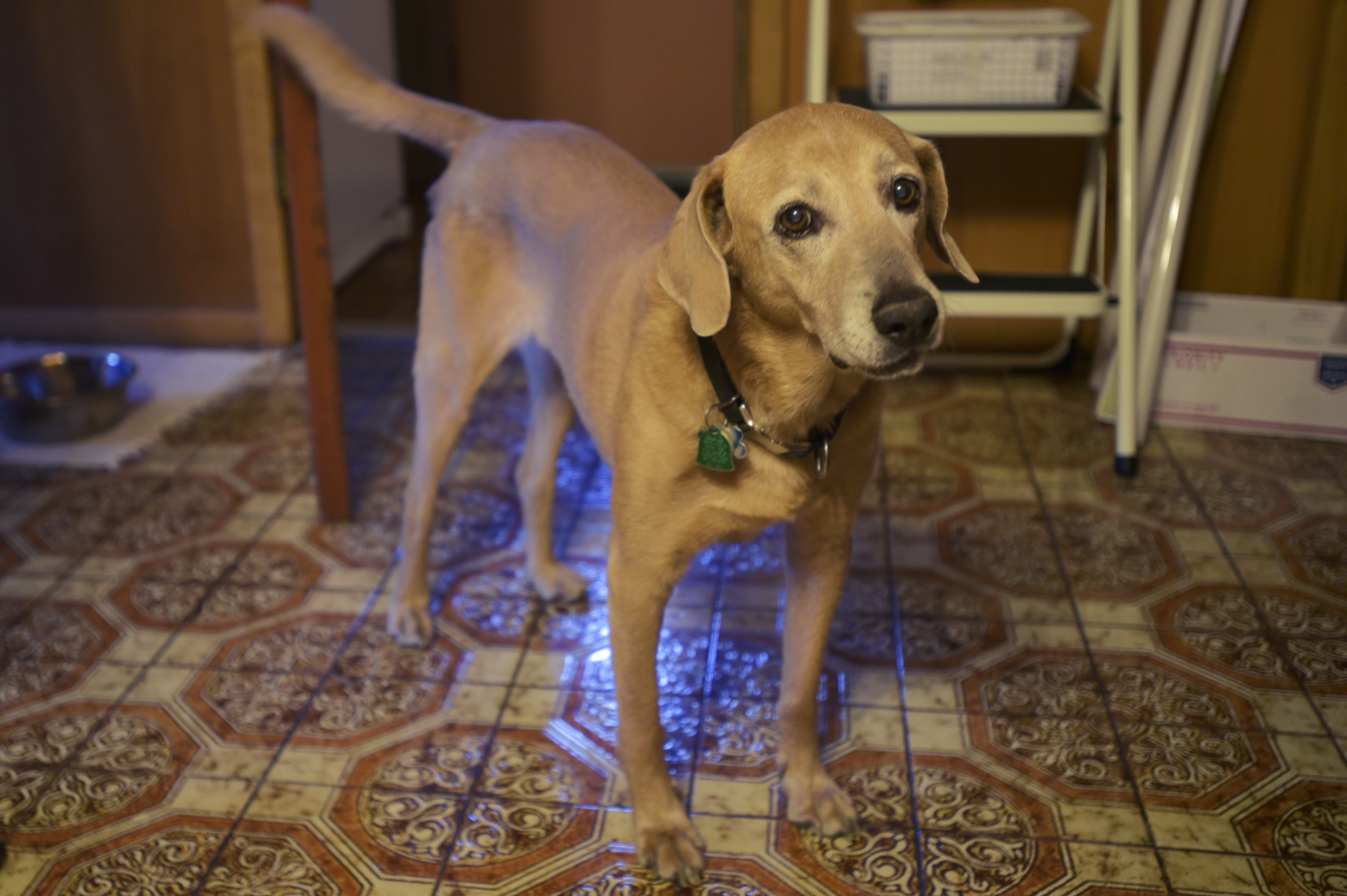
So does splaying out on the kitchen floor tile, as my dog, Gus, would tell you if he could. Photo by David Minton
Gus doesn’t like the air conditioner in our new house one bit. On move-in day April 1 and for a day or so after, he wouldn’t go down the hall towards any of the bedrooms. I didn’t figure out why, and it passed. Only later did I understand that it passed because I turned off the air conditioner until June.
We had an unusually cool, wet spring. I wanted the peace and quiet. My house was built in 1961. Air conditioning for this house, like many homes of this era, came later. That means the system equipment that would be in the attic of a newer home was installed in our hall closet.
It’s loud.
Really loud.
After I turned the air conditioner on for the summer, Gus preferred to stay in the living and kitchen areas. When pressed, he would come into the first bedroom, which is my office, and hid under the desk while I worked.
Gus is an old guy. Come November, he’ll be 14, which makes him about 78 in dog years. After we sold the farm and moved to town, it was fun to watch him recognize that his patrol duties had shrunk to a city lot down from 10 acres (with the additional security risk of a creek running through part of it).
You could almost see it in his eyes. “Hey! This is great! I can retire!”
We have a new routine that includes lots of fake patrols through the drainage ditch behind the house. Instead of napping under the porch, he naps in the garage.
At night, he’d whimper and cry when I headed for bed, which soon became crying whenever I went down the hall. Still, it took me a few days to figure out it was the air conditioner that was bothering him. At first, to help him out, I carried him down the hall, past the unit, at bedtime. But then, he started getting anxious as I would get ready for bed. Clearly, he didn’t even want to be carried down the hall. I looked again and saw that there are intake vents both in the hall and in the master bedroom.
I gave up.
I set up the laptop in the kitchen. I hardly use the big Mac the way I used to for writing and research. I moved the sewing machine to the dining room. And every night since June, I throw the big decorator pillows on the floor for Gus, and I sleep on the sofa.
When Sam went to kindergarten at Argyle Elementary School, he was terrified of the school bells. The teachers worked it out that Sam would always be outside for a fire drill before the alarm went off. But the 9 a.m. attendance bell was becoming a problem. The kindergarten teacher told Principal Gaye Pittman that Sam would watch the clock earlier and earlier each day. He was developing an increasingly elaborate routine to try and anticipate the moment the bell would sound.
Gaye knew just what to do. She turned the bells off. Teachers would just have to remember to take attendance at 9 o’clock without a bell.
It’s August, Gus. It’s Texas.
We’re not turning it off.