

Overheard in the Wolfe House #288
Sam: I try to give nonverbal commands to dogs … and horses.
Peggy: Oh, yeah?
Sam: But Tracy says horses understand words.
Peggy: You think so?
Sam: Some words.
Peggy: Which ones?
Sam: Well … “walk” and “whoa.”
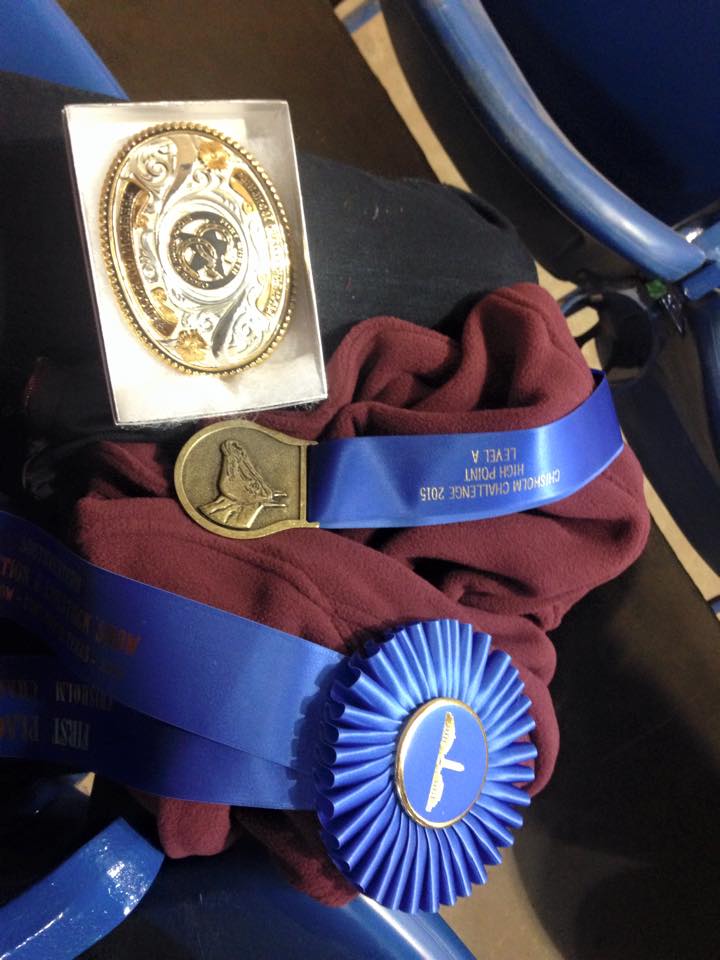
Chisholm Challenge 2015: Working Trail (the buckle-winner)
Yes, internet friends, I was so engrossed in his ride I forgot to follow the canter over the poles.
Chisholm Challenge 2015: Showmanship
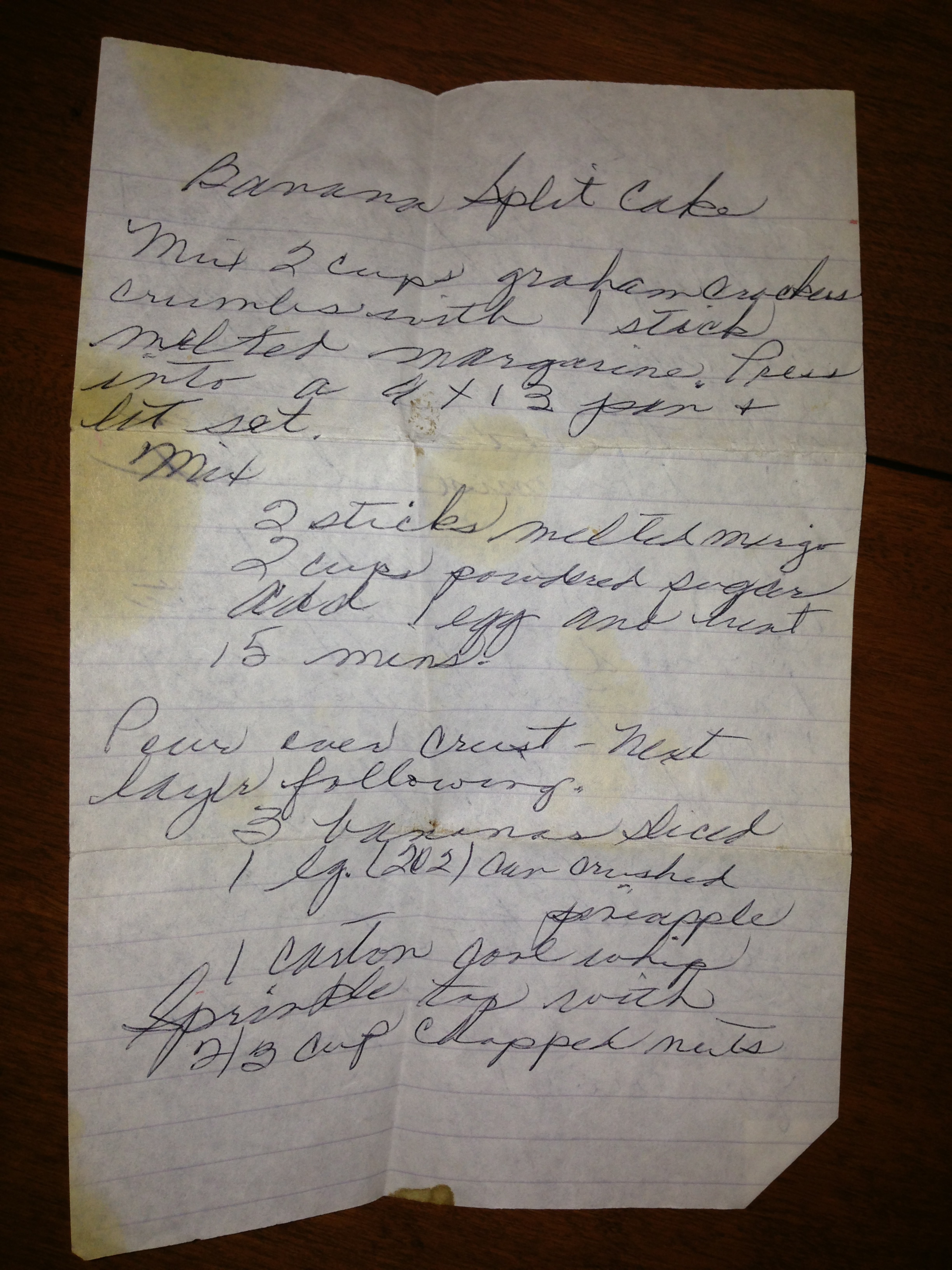
Old-school cakes: Banana Split Cake
Regina has a birthday this month and we are going to celebrate by doing what we did last year: going to Johnny Cace’s for Sunday brunch. I’d always thought of that venerable Longview restaurant as a supper club, but last year we stumbled that way after the new Cracker Barrel had to close in the middle of the day because the power went out. Brunch was everything you’d expect from a New Orleans-inspired eatery.
But, we’ll have to make the most of this weekend. They are closing soon.
I started going over Regina’s bountiful collection of cake recipes, to see if there’s something birthday-ish I can bake and bring her to celebrate.
I don’t think this one will travel well, but it starts in the way so many of my favorite desserts start: a graham cracker crust.
Building real community: jobs, jobs, jobs
About a month ago, I heard a local preacher tell a story that showed we have a long way to go to build a real community.
I’m not sure his story resonated around the city the way that it should have — it certainly resonated with me — but that could partly be my fault.
When local civil rights leaders organized a summit for law enforcement, I was assigned to cover it. Denton hasn’t seen the kind of unrest that Ferguson, Mo., and other cities have, but no one wants to see that kind of unrest either if issues can be addressed proactively. I live-tweeted the event and reported the conversation for the Denton Record-Chronicle. I didn’t get to write the Rev. Chambers’ story in my report, but I’ve lost count how many times I’ve retold it in my own conversations with friends who ask how Sam’s job hunt is going.
The Rev. Cedric Chambers came to lead Mount Calvary Baptist Church from West Dallas recently, after the Rev. Logan passed away. A few members of his church told him their concerns about several young men who were on the wrong path. Without some intervention and, frankly, some help, the future for these four young men wasn’t good, Rev. Chambers said.
The church community put together some social supports for these young men, but what these fellows needed most was summer jobs. Chambers sat down and wrote letters to many Denton business leaders and made a proposal. The church would help make sure these young men would be successful if given a chance of employment. Chambers told the crowd that he had pursued this tactic in West Dallas before and it had been successful. But he was surprised when not a single business leader in Denton contacted him about the church’s proposal.
I very much wanted to stand up and tell the rest of the room that what Chambers experienced in Denton was not unusual.
Sam graduated from North Central Texas College with his associate’s degree two years ago. He also has a certificate in computer information and technology. But he still works the job he got when he graduated high school in 2006, sacking groceries part time in a Denton store.
It took a year, but finally, the state agreed he was underemployed and re-opened a case to help him get a job. In other words, he’s got the right social support he needs to be successful.
Yet, for two years now, the business community hasn’t given him a real chance at bat. (He’s suited up twice thanks to friends who knew him well and wanted to put him in the game.)
Time and time and time again we hear that prospective employers just don’t want to take the chance — even in the tech sector which is scrambling for dependable workers.
A city can have a lot of creative, hard-working people, and their efforts can, and do, go a long way toward building community, but as the Rev. Chambers and my son know all too well, fear forfeits the game every time.
Overheard in the Wolfe House #287
Tom (old family friend, at Chisholm Challenge): When I saw Sam yesterday, I asked him if he was growing a beard.
Peggy: Oh yeah?
Tom: He said, “But not a white one like yours.”
Overheard in the Wolfe House #286
Sam: Are you ready for some big news?
Peggy: Yes, I am.
Sam: I took first in trail. (pauses) And … I found out on Facebook.
Random thoughts running Frenchtown Road
Michael woke me today and insisted I run with him. “It’ll be the last time,” he said.
It’s a funny way to celebrate a launching, but that’s what it was. Last year was tough for him. He had started his adult life after graduating TCU in 2013 and then had to move back home last January. I got a front row seat watching what our economy is doing to the 20-somethings. At the end of one of his worst days, I found myself offering a most grown-up salve to his wounds, pointing to the barstool in the kitchen and pouring him a generous shot of Old No. 7.
In the past year that he’s lived here with Sam and me, we often ran together. His normal pace is crazy faster than mine, but he said slowing down to run with me strengthened other muscles. True or not, it was still a nice thing to say and do — slowing a 7:00 mile to run your mom’s 10:00+
Eventually, he righted himself. Today he packed up the car and drove to his new life in Austin. 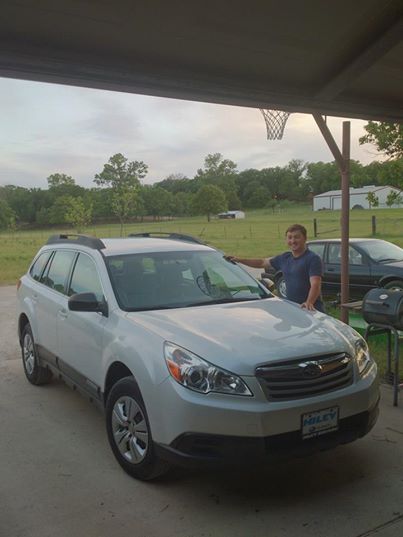
I resisted temptation to grab the camera and document the day (this photo is from one of his good days earlier this year), remembering back to Paige’s first day of kindergarten. She was the youngest, but she was feisty and she couldn’t wait to prove she was big like her brothers. When it was her turn to hop out of the car and head to her classroom for the first day of school, she did it with confidence and determination. Who was I to turn into a blubbering idiot about all my babies gone to school and ruin her first day being big for real?
So I just watched her from behind the wheel of the old Dodge Caravan and marveled at the moment.
It was icy cold today, but it was a little like that hot August day 30 years ago I drove my un-air conditioned car across the Nevada desert to Sacramento to start my grown-up life: Michael, being big for real.
See Sam Drive: Tractor Edition
Sam and I re-homed the tractor today, one of many steps away from the farm and toward life in town.
He drove the tractor as I followed him in the pickup, loaded up with nearly all the tractor accoutrements Mark had acquired over the years, down Frenchtown Road for the last time.
Mark taught Sam to drive the tractor when he was a teen. He wanted Sam to learn to drive a car and figured this was a good way to see how he’d manage. Better to mow down a few trees or nick a fence or two in the relative safety of your Texas-sized front yard in that journey of self-discovery.
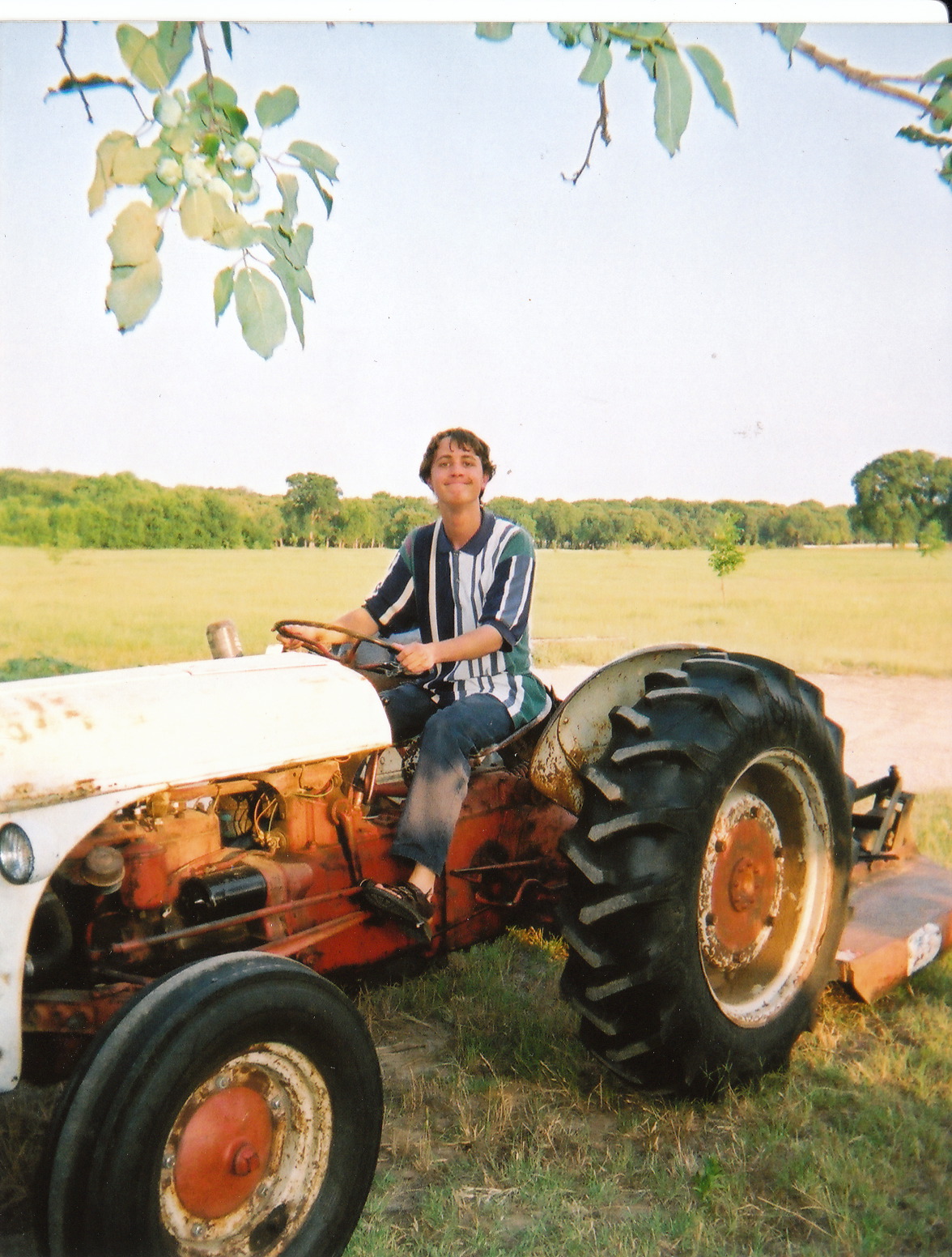
Sam, Master of the Tractor/Photo by Mark Wolfe
Mark was right. Sam could do it. When he pulled the tractor up under the carport this afternoon and parked it perfectly, Susan exclaimed, “Wow, Sam, you’re a professional!”
Sam wasn’t going to tolerate any tears from me, so I blinked them back behind my sunglasses.
“I made it!” he beamed.
Overheard in the Wolfe House #285

Left to right: Grandma, Grandpa, Chris, Peggy, Sam, Matt
Aunt Chris (above the chatter around the table at the bagel shop): Are you bored, Sam?
Sam (staring off in the distance): Oh, you’re never bored when you’re with family.
Happy 2015 Everyone!