

problem-solving
Brainstorming 101: Fixing the Garage Door
After Sam finished fixing problems that came with the Lion upgrade, he suggested that we tackle the garage door. We have an automatic door opener that works when it wants to.
And it doesn’t want to very often.
It’s been a great chance to brainstorm solutions. We’ve watched videos on YouTube. We’ve called Uncle Matt. We’ve taken turns trying things and watching the trouble spots to come up with ideas.
And because it’s primarily a mechanical system, it seems that each thing we try brings a small reward, whether it’s knocking down wasp nests to remove a blocked pathway or lubricating parts to lessen the drag on the motor. Each step brings progress.
Sam has decided that we still have some kind of electrical problem, though. He says because we have to hold the button down for it to open there must be some kind of wear in the wires. I told him I’d like to replace the sensors — they look like they’ve just about had the life kicked out of them, they’ve been bumped and bustled so much — and he’s agreed.
And if that doesn’t do the trick, he’s going after the wiring.
Expert Consultation Coming
I hope.
The ARC sent me a link to a website that is supposed provide self-help for adults with autism in the work force, called JobTIPS.
I asked Sam to take a look at it. Some of the pages are about interacting with the supervisor and how to keep a job, so it applies.
I think it looks good and the information is helpful, and clearly presented.
He said he’d take a look at it this weekend and let me know what he thought — I’m hoping to blog it.
Stay tuned.
First Things First
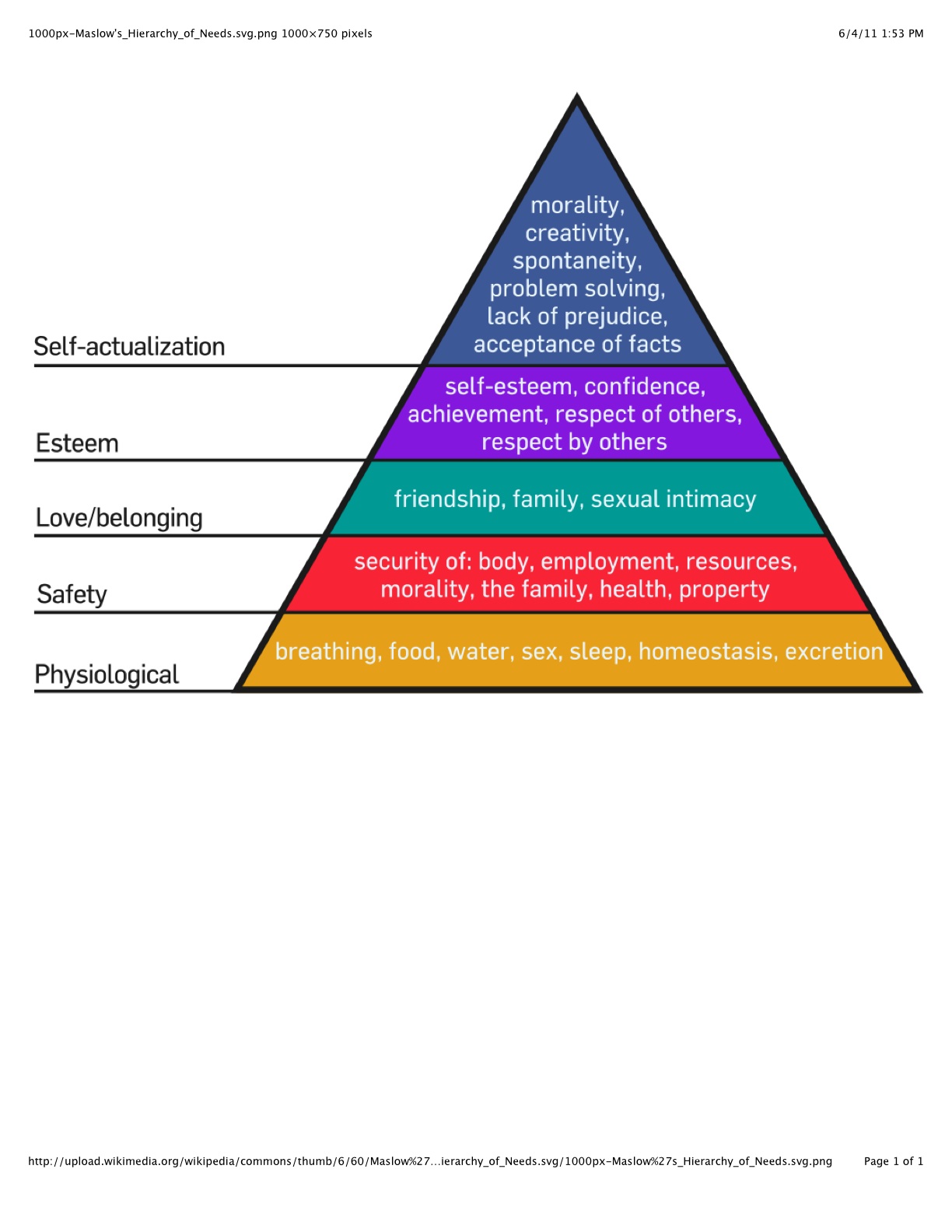
Sam and I spent a good portion of last Saturday afternoon talking about Maslow’s Hierarchy of Needs. The house is going up for sale and he’s very upset about it.
We are about to become another in what is sure to be a long exodus of refugees from the Barnett Shale. An operator has built a gas processing plant next door. I’m not sure we can even sell the place, but I have to try.
My brother-in-law is an attorney for a pipeline company in another state. Even his eyes popped when he saw what we’re being asked to put up with.
(image borrowed from Wikipedia)
Sam has known this has been coming for a long time, but struggled to see the new order of things once we leave. I’m not surprised. People with autism can barely understand our cryptic social orders to begin with. Upend the whole thing and he doesn’t know what to do.
Well, the wise Mr. Maslow said that first comes things like breathing and food and water. Breathable air is already in short supply around here, having a next door neighbor dehydrating gas, blowing off relief valves and burning raw gas to run thousands of horses every hour to keep that 16-inch line compressed adds serious insult to injury.
Not to mention, if that 16-inch line ever goes, we go with it.
Seeing it on the pyramid, along with things like food and water helped him understand.
He’s fretted for more than a year about what would happen to friendships if we aren’t living in the same place we’ve always been. Half his school chums are graduating, too, and getting jobs far from here. Somehow, Sam saw himself as the anchor in this changing storm.
But friendships are much higher on the pyramid. As a visual aid, Maslow scores for us. Sam finally understands why the exodus is necessary.
First things First.
Saturday in Richardson
I will be talking to parents at Education Service Center Region 10 from 9 a.m. to 1 p.m. Saturday.
The meeting will be in the Mockingbird Room in the Abrams Building, 904 Abrams Road, Richardson.
I will be sharing information about Texas Parent-to-Parent and People First language for the first half of the meeting — talks that have been developed and refined by the good people at Texas Parent-to-Parent
During the second half of the meeting, we’ll discuss ethics in treatment decisions, why it’s important, and how to be successful with it. This talk was developed first by Shahla Ala’i-Rosales, a professor of behavior analysis at the University of North Texas, and an expert with years of clinical experience treating children with autism.
I’ll bring a book or two to give away.
The Best Accommodation
I asked Sam tonight about a test he’ll be taking tomorrow in his computer tech security class. When he first started at North Central Texas College in 2006, he would often retreat to their student success office to take any test. He needed the quiet room, free of distractions, and the extra time, to get it done.
But the past few years, I’ve noticed Sam working diligently through test study guides. Now, these guides are often long — perhaps 50 questions or more, clearly pulled from past tests, possibly on the upcoming test.
Sam works through them all methodically. He looks up the answer in the book or his notes and types it out in complete sentences on a virtual piece of paper. He puts in several hours each time he prepares. And he rarely does poorly on any test he takes any more.
I was curious whether he was going back to the student success center to take the test and Sam said no, he doesn’t need that accommodation much any more, especially if a professor can accommodate him another way.
I was a little sketchy on what that detail might be, but Sam has learned to advocate for himself and the professors there at NCTC have come to understand him, too.
I asked him whether he thought those study guides were a good thing. He said they were the best accommodation of all. Once he answered something from the guide, it was “in my head for good,” he said.
I wondered about all those students who might see a 50-question guide, skim it, and say to themselves, “oh, I know all these answers.” I know I was one of those kind of students in my day. I got away with not going fully into the corners as I learned things, something I do not do anymore. I got bit one too many times in my life by not quite knowing what I should know.
Most of the time, all that is required is a full, careful reading of the material. And then it’s in my brain for good, too — or at least enough that I know it exists and where to find it again.
He said the funniest thing at the end of our little exchange.
“I don’t need many accommodations any more. I feel I’m fully grown up now.”
Man and car keys, part two
When Sam got home from work last night, he said he was a little embarrassed by what happened. I told him everyone has locked their car keys inside their car from time to time. I’ve done it more than once. It’s easy to do.
Then I told him that Ms. D (his speech therapist in high school) suggested a hide-a-key.
He looked at me quizzically for about ten seconds, and then a huge grin broke out on his face. “Did you put something on Facebook?”
(I was so excited that he connected all those dots.) I put something on the blog, I told him, and then linked to Facebook.
“People learn from our experiences, Sam,” I said.
“I know,” he said.
He was skeptical about the hide-a-key option — he is his father’s son, that’s for sure — but then agreed we needed to get more information.
We decided we’d go see a locksmith and determine whether hide-a-key is an option. We also are going to learn about calling a locksmith when you’re locked out and other options.
What I’ve learned from this is how much we take for granted our children’s ability to solve problems when we send them out into an ever-more-complicated world. When our children are born, we marvel at their first words, first steps — but nature does all that. We parents don’t do a thing.
After doing a story about moms with HIV, I recognized that what parents owe their kids is a set of survival skills. Those moms with HIV knew their time was limited and the best give they could give their kids is the ability to stand on their own two feet. Before then, I did things for my kids out of convenience or a lack of consciousness. I saw that I could be crippling them for the long term and changed my ways.
The kids, by the way, didn’t always like it. They saw friends whose parents “did more” for them. Mark and I often got grief for that. (Michael thanked me last year, after helping several friends learn to do laundry. Big-time delayed gratification on my part, there.)
With Sam, I worry whether he has enough “generalized” problem-solving ability. I called my parents and asked for help those first years out of the house, and in my own apartment. Once they talked me through how to handle a simple repair or negotiations with a business, though, I could apply what I learned in other situations. I see Michael doing that now — in his second year out of the house and looking forward to his first year in an apartment.
Sam is doing that to a great degree, yet I still have this nagging sense that life can still throw him lots more curve balls than he’s prepared for.
Man outside, car keys inside
Sam called for help today; he’d locked his keys in his car after arriving at his workplace from his computer class at North Central Texas College.
I hopped in the pickup and headed across town from my workplace to his, calling him when I was at the light out front of Albertsons. He told me he was in front of China Garden buffet.
He never said anything about getting something to eat, so I didn’t know why he would be hanging out in the foyer of the restaurant. When I pulled up, he didn’t come outside. In fact, he went further in.
I went in to the restaurant to get him, and he was surrounded by three employees at the restaurant. I didn’t like the looks of it at all. I asked him to step out into the foyer with me so we could avoid a scene.
He asked me to go unlock his car, and I told him I didn’t know where it was, please walk with me. We were about halfway up the parking lot when he told me he was in the middle of lunch and he hadn’t paid for his meal yet.
We turned back around to see an employee step out and toward us. I quickly explained the confusion, and we paid the ticket right then — plus tip, even though the place was a buffet.
By this point, way too many things had happened out of order for Sam to catch up. But he was holding his cool pretty well.
We turned back around towards the car again, and got his keys out. Then he said he wanted to go back and finish his lunch.
I offered to go back and help him try to get back into the buffet, but the servers were ready.
“We saved his table for him,” one said.
Sam and I tried to debrief the situation, since our miscommunications made it worse at first. We didn’t talk about the elephant in the room, though.
How would you have solved this problem if I wasn’t 15 minutes away with the spare key?
I plan on asking him that question soon. We’ll see what he says.
Cutting, pasting, passing it on …
From The ARC
The Screening Room – Critics Choice
Facilitated by Charlene Comstock-Galagan
Friday – March 25, 2011
9:00 am – 11:00 am
Location: To Be Determined
Join Charlene for a thought provoking discussion and screening of the latest and greatest
visual media and their deepest messages about inclusion and the meaning of belonging in
the 21st century. March is ID/DD Awareness Month. You don’t want to miss this opportunity!
Special Education – The ARD/IEP Process
Presenter: Charlene Comstock-Galagan
Friday – March 25, 2011
12:30 pm – 4:00 pm
Tarrant County – Specific Location: To Be Determined
Determining the special education services for a child/student is done through a strategic,
step-by step planning process. A process that crumbles if the foundation is cracked, a
critical step in planning is missed or out of order, or planning takes place without thoughtful
discussions based on the individual needs of a child/student.
DON’T MISS THIS OPPORTUNITY!
Charlene will review the ARD/IEP Planning process and share tools and strategies that
have produced positive outcomes for students who have an Individualized Education Program – IEP.
· The ARD/IEP agenda
· The purpose of assessment beyond eligibility
· Integrated and measurable goals and objectives
· Modifications & accommodations (across school settings)
· Supports for or on behalf of the student
· Placement decisions using a Planning Matrix
· Prior Written Notice… and more!
Employment For ALL – 2 Sessions (Customized Employment & Discovery, The Process)
Session 1: Customized Employment, an Overview
Presenter: Michael Callahan, International Consultant on Employment & Transition
Saturday – April 2, 2011
9:00 am – Noon
Location: To Be Determined
DON’T MISS THIS OPPORTUNITY! Participants will leave inspired and empowered with information
and strategies that make employment a viable option for persons once thought to be unemployable.
Session 2: Discovery, the Process
Presenter: Michael Callahan, International Consultant on Employment & Transition
Saturday – April 2, 2011
1:00 pm – 4:00 pm
Location: To Be Determined
The Discovery Process is a strategy used as a substitute to comparison-based testing procedures
in that it utilizes already-existing information rather than information developed through formal
assessment methods. It takes into account the applicant’s entire life experiences rather than single
instances of performance.
DON’T MISS THIS OPPORTUNITY! Mr. Callahan will review steps need to complete the discovery
process. An interactive process that allows the provider to get to know the applicant and to assist
in identifying personalized preferences and conditions for employment as well as individual
contributions to be offered to employers.
Person Centered Thinking & Plan Facilitation
Presenters: Laura Buckner, M.Ed., LPC – University of Texas Austin & Jeff Garrison-Tate, M. Ed. Texas A&M University
May 9 -10, 2011 ▪ 9:00 – 4:00 │ Person Centered Thinking
May 11 – 12, 2011 ▪ 9:00 – 4:00 │ Plan Facilitation (Prerequisite – Completion of Person Centered Thinking)
Both 2 day sessions will be held at TCU – Dee Kelly Alumni & Visitors Center – Ft. Worth
2820 Stadium Drive – Ft. Worth, Texas 76109
Space is limited & registration is required!
For additional information about the sessions above, please refer to the attached fliers.
If unable to open the fliers please visit: www.arcnetc.org.
Just a Little Radioactive
In one of the dozens of “grief books” that friends gave me after Mark died, I learned a helpful lesson. When something bad happens to you, people around you may react to you as if you are a little radioactive.
Granted, I probably was. People want to show that they are compassionate, but most aren’t ready for a deep walk in the emotional woods with you on a moment’s notice. It’s a strange place to be, socially. People circle around you to help insulate and protect you, but if you need someone to be with you in a big way, the list of those capable is pretty short.
And even the capable ones have their days that they just can’t.
That’s good to know. I was pretty tender-hearted back then — and still am often — so it helps to know that I scared people even more than I normally do, and to not take it personally.
I ended up spending a year with a grief therapist. I could have joined a group and got the same kind of support from others, but I recognized that my level of introspection (some might call it navel-gazing) would probably scare the people who could see the thestrals, too.
The perspective is helpful as I look back on Sam’s early childhood. People are especially challenged in supporting you because it’s not a true tragedy. As the years go by, I’m finding it easier to lay a lot of those experiences to rest, knowing that some people were trying, but what I might have been seeking was more than they had to give.
Yes, Virginia, sometimes there isn’t a Santa Claus. But, you’ve got a spine, and prayer, so you’ll be fine.
We’re going through another round of that “radioactivity” in our lives. I’m pretty savvy to it — the list of people who can tackle the topic is small, and I have had to re-arrange my life somewhat in acknowledgement of that. I’ve even overwhelmed my family from time to time. Most of the time when friends and acquaintances push for information, I tell them it’s really not suitable for polite conversation.
But I forgot that little social rule today, and shared too much with someone who just seemed endlessly curious and capable of the conversation until I got the look. I knew that look, it was the get-me-out-of-this-conversation-this-lady-is-radioactive look.
Conscious parenting
When the boys were still babies, Mark and I watched other parents with their trials and tribulations.
After watching enough toddlers and preschoolers run to their mother’s arms when they were hurt — sometimes running right past father on the way — Mark decided it was important to him that our children be comforted as readily by him as by me.
He felt that he was at a disadvantage because I was the one with the breasts. Frankly, though, it wasn’t hard to to convince the boys that daddy’s hugs and kisses made the boo-boos go away, too. If something happened when Mark was around, he swept in and gave the lovin’ required. Sometimes I’d bring the band-aid and give it to Mark to apply.
Age plays with the memory, to be sure, but I cannot remember ever seeing any of our children, hurt and crying, and in Mark’s arms but reaching for me, instead.
I’m not exactly sure what it got us, but now that Mark is gone, I’m grateful for it.
Conscious parenting was all that was required.